
Published on
There are two numbers in circulation for AI agents, and they are about 5,000 times apart.
One camp says an agent costs $150,000 to $500,000. The other says they built one over a weekend with an AI subscription and a few API keys. Both are telling the truth. They are describing different things: one is a piece of production infrastructure with guardrails, logging, and compliance; the other is a personal tool with one user who already knows what it should do.
This guide breaks down what AI agents actually cost in 2026, who charges what, which line items surprise people, and how to get a useful number for your own project before you ask anyone for a quote.
Short answer: A simple single-task AI agent costs roughly $1,500 to $8,000 when built by a freelance specialist, or $5,000 to $30,000 through an agency. A production task-execution agent that touches your business systems runs $8,000 to $40,000 freelance, or $50,000 to $150,000through an agency. Multi-agent enterprise platforms start around $150,000 and pass $500,000 in regulated industries. On top of the build, expect running costs of roughly $100 to $5,000 a month and annual maintenance of 15% to 30% of the build price.
First, What Counts as an AI Agent?

An AI agent is a system that takes a goal, decides the steps itself, uses tools or APIs to carry them out, and keeps going until the job is done or it hits a stopping rule. The defining feature is that it does things, not just says things.
This matters for cost, because the three things people call "an agent" are priced very differently:
- A chatbot answers questions. It reads; it does not write. The budget ranges in our breakdown of what businesses pay for chatbot development apply here, and they are much lower.
- An AI-assisted automation runs a fixed sequence with a model doing one step inside it, such as classifying an email before routing it. The path is predetermined.
- An agent chooses the path. It might call three tools, check a result, change approach, and try again.
That last category costs more because unpredictability has to be contained. Every action an agent can take is an action someone has to test, log, permit, and occasionally undo.
If your use case is really a fixed sequence, say so out loud before you brief anyone. Plenty of requests that arrive as "we need an AI agent" are better solved by automating repetitive business tasks with AI at a fraction of the cost.
AI Agent Development Cost at a Glance
Agent type | What it does | Freelance build | Agency or enterprise build | Typical timeline |
|---|---|---|---|---|
AI step inside an automation | Classifies, summarizes or drafts within a fixed workflow | $300 to $3,000 | Rarely quoted separately | Days to 2 weeks |
Single-task agent | One job end to end, such as lead qualification or inbox triage | $1,500 to $8,000 | $5,000 to $30,000 | 2 to 4 weeks |
RAG-grounded assistant | Answers from your knowledge base, limited actions | $2,000 to $20,000 | $10,000 to $80,000 | 3 to 8 weeks |
Task-execution agent | Plans, calls tools, updates CRM or ERP records, loops until done | $8,000 to $40,000 | $50,000 to $150,000 | 6 to 14 weeks |
Multi-agent platform | Several specialized agents coordinating across enterprise systems | $40,000 and up | $150,000 to $500,000+ | 4 to 12 months |
Freelance ranges reflect typical project pricing on vetted AI marketplaces in 2026. Agency ranges reflect commonly published vendor pricing. Both are starting points for a conversation, not quotes.
Why the Same Agent Costs $8,000 or $120,000
The gap is not usually about skill. It comes from three things.
Who is doing the work. An agency price includes project management, QA, a designer, a solutions architect, and a support contract. A freelance specialist prices their own hours. Rates vary a lot by region too, and our guide to what it costs to hire an AI freelancer shows how those bands move with seniority and location. The trade-offs between the two routes are covered in our comparison of working with a freelancer or an agency on AI projects.
What "done" means. A demo that works when you type the expected input is maybe 20% of a production build. The other 80% is the unglamorous part: authentication, rate limits, retries, what happens when an API returns nothing, what happens when the model picks the wrong tool, who gets alerted, how you roll back an action that should not have happened.
How much the agent is allowed to do. An agent with read-only access is cheap to ship. An agent that can issue refunds, send emails to customers or change records in your CRM needs permission design, approval steps, and an audit trail. That jump is where budgets double.
What Actually Drives the Price
1. The range of actions
Read-only agents are the cheapest safe thing you can build. Each write action you add brings its own testing, permissions and failure handling. Start by listing every action the agent may take, then split it into "can do alone" and "needs a human to approve". That list predicts cost better than any feature description.
2. Integrations
This is the line item teams underestimate most. Connecting to a modern, well-documented API is a known quantity. Connecting to an undocumented internal system, an old ERP or a tool with awkward authentication can take as long as the agent itself. Budget per system, not as one lump, and expect legacy connections to cost the most. Specialists who handle AI integrations with existing business systems can usually scope this quickly once they see what they are connecting to.
3. Data readiness
Most cost breakdowns leave this out, and it is often the hardest part. An agent is only as good as what it can look up. If your product data, policies or customer records are scattered, inconsistent or out of date, someone has to clean and structure them before the agent is useful. For retrieval-based agents, that includes chunking content and setting up search, which is why teams bring in help with vector database design for retrieval systems.
Rough planning rule: if nobody in your company can confidently say where the correct version of a given fact lives, add weeks, not days.
4. Model choice and token design
Agents consume far more tokens than chatbots because they loop. One task can mean several model calls, each carrying context, tool definitions and intermediate results. Choosing which model handles which step, and how much context it carries, is a cost decision as much as a quality one. Help with foundation model selection for a specific use case usually pays for itself on high-volume agents.
5. Guardrails and human oversight
The more autonomy an agent has, the more it needs limits. OWASP's 2026 Top 10 for LLM Applications ranks excessive agency third, where a system gets more functionality, permissions or autonomy than its task requires, and the recommended defense is minimum necessary agency with human approval on irreversible actions. Building that properly costs money. Skipping it costs more the first time an agent does something expensive on its own.
6. Compliance
Healthcare, finance and anything handling personal data at scale need audit trails, access controls and documented data handling. That typically adds a meaningful percentage to both the build and the monthly run cost.
The Running Costs Nobody Puts in the Pitch Deck
An agent is not a project you ship. It is a system you operate.
- Model usage. Here is realistic arithmetic. Say your agent handles 1,000 tasks a month, and each task uses about 30,000 input tokens across its loops plus 3,000 output tokens. On a lightweight model such as Claude Haiku 4.5, which Anthropic currently lists at $1 per million input tokens and $5 per million output tokens, that is roughly $30 for input and $15 for output, so about $45 a month. Run the same volume on a frontier model and you can multiply that by 10 or more. High-frequency multi-agent workloads can pass $10,000 a month.
- Infrastructure. Hosting, queues and a vector database typically run $200 to $2,000 a month for a small to mid-sized deployment, more at scale.
- Observability. You need traces showing why the agent did what it did. Tooling plus storage usually adds a few hundred dollars a month, and regulated setups need more.
- Maintenance. Prompts drift, models get updated, APIs change, your business changes. Plan 15% to 30% of the build cost per year.
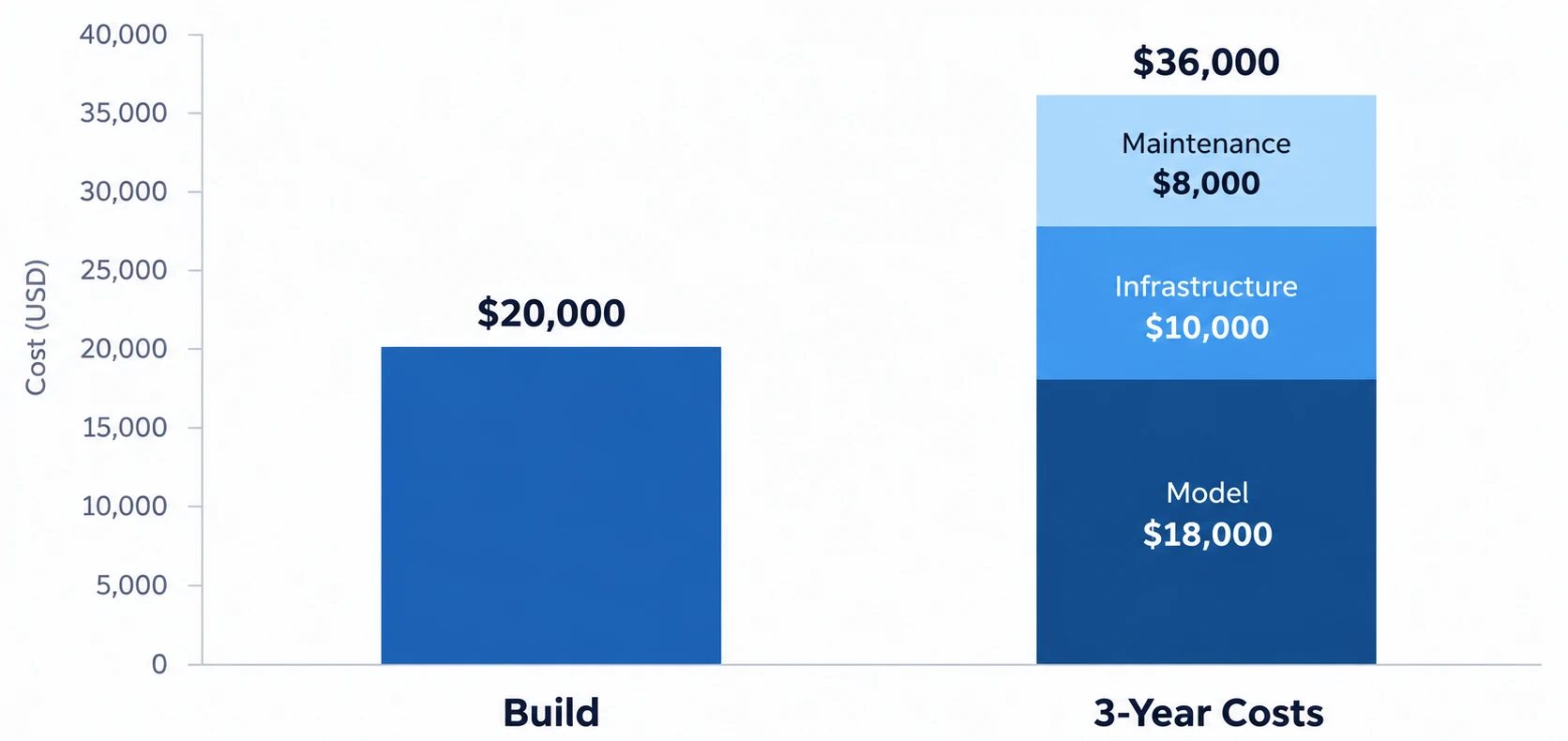
Put together, a $20,000 agent with $600 a month in running costs and 20% annual maintenance comes to roughly $20,000 + $21,600 + $12,000 over three years, so about $53,600. The build is a bit over a third of what you actually spend. That ratio is worth showing to whoever approves the budget, because the second-year invoice is where most of the disappointment happens.
Can You Just Build It Yourself?
Sometimes, yes, and the people saying so are not wrong.
If the agent has one user (you), runs on your machine, touches systems you personally control, and nothing terrible happens when it fails, modern AI coding tools can get you there fast and cheap. For internal experiments, that is a smart first move. It also teaches you what the real requirements are, which makes any later quote more accurate.
Where the DIY route breaks is the step from "works for me" to "runs the business":
- Multiple users and permissions
- Secrets and API keys handled properly
- Error handling when an external system is down
- Cost controls so a loop cannot run up a bill
- Logs good enough to explain a decision to a customer or an auditor
- Someone available to fix it when you are on holiday
This is the same pattern we covered in vibe coding and where it starts to get messy. Fast to build, expensive to operate blind.
A sensible middle path: prototype it yourself, prove the workflow is worth automating, then bring in AI agent developers who handle orchestration, tool use and system integrations to harden it. You pay for engineering only where it changes the outcome, and you arrive with a brief based on something real.
Seven Ways to Spend Less Without Getting Less
- Automate one workflow, not a department. Agents scale after they work, not before.
- Ship read-only first. Let the agent recommend actions for a few weeks before it takes them. You get the accuracy data and a lower build cost.
- Keep a human on irreversible actions. Refunds, outbound customer emails and record deletions are cheaper to approve than to reverse.
- Use a cheap model by default. Route only the hard steps to a bigger model.
- Check if your existing platform already does it. If you run on a major CRM or productivity suite, their native agent tooling is often cheaper than a custom build, and workflow tools like n8n cover a lot of ground. Specialists such as n8n experts who build automation workflows can often deliver in days what a custom agent would take weeks to replicate.
- Pay in milestones. Fixed milestones make scope creep visible, and scope creep is where agent budgets actually die.
- Write the brief before you ask for prices. Vague briefs get padded quotes. The structure in our guide to writing an AI project brief covers the goal, data, systems and success criteria that every quote depends on.
Three Realistic Budget Examples
These are illustrative scenarios, not client projects, to show how the pieces add up.
- A 12-person agency wants an agent that qualifies inbound leads and books calls. One integration (their CRM), one calendar tool, read plus limited write access, human review for the first month. Freelance build around $3,000 to $7,000, running costs under $100 a month, light maintenance.
- A mid-sized ecommerce brand wants an agent that handles order status, returns eligibility and refunds under $50. Three integrations, a policy knowledge base, approval step for refunds, logging for disputes. Freelance build around $12,000 to $30,000, running costs $300 to $900 a month, maintenance roughly 20% a year.
- A financial services firm wants multiple agents across onboarding and support. Compliance review, audit trails, access controls, several legacy integrations, formal testing. This is where six-figure agency pricing becomes reasonable rather than inflated.
How to Get an Accurate Quote
Ask two or three builders to price the same written brief, then compare what each one includes rather than the headline number. A good quote tells you:
- Which actions the agent can take alone and which need approval
- Which systems it connects to, and which integrations are out of scope
- How the knowledge or data layer gets built and kept current
- Expected monthly model and infrastructure costs at your volume
- What monitoring and logging you get
- Who owns the code, prompts and configuration
- What maintenance costs after launch
Asking to see a live agent they have built, and what happens when it fails, tells you more than any deck. The rest of that process is in our guide on vetting AI freelancers before you hire.
If you want the outcome without running the project, managed delivery is a different model from hiring directly. Botpool One handles AI builds end to end, which suits teams with no internal capacity to manage specialists.
Frequently Asked Questions
How much does it cost to build an AI agent?
A simple single-task agent costs around $1,500 to $8,000 from a freelance specialist, or $5,000 to $30,000 from an agency. Production agents that act inside business systems run $8,000 to $40,000 freelance and $50,000 to $150,000 through agencies. Multi-agent enterprise platforms start near $150,000.
How much does it cost to develop an agentic AI system?
Agentic systems, where several agents plan and coordinate, are the most expensive category. Published vendor ranges run $150,000 to $500,000 and higher in regulated industries, mainly because of orchestration, governance and compliance work rather than the models themselves.
How much will it cost to develop an AI agent in 2026?
Build prices have stayed broadly stable while running costs have fallen, because model pricing per token keeps dropping and lighter models now handle many steps well. The cost of engineering, integrations and data preparation has not fallen, and those are the larger share of most budgets.
How much does it cost to develop AI generally?
Applying existing models to your business costs thousands to tens of thousands. Training a new frontier model costs tens or hundreds of millions. Almost every business AI project sits in the first group, including agents.
Is making AI agents profitable?
It depends entirely on what the agent replaces. The honest test is to calculate the hours or error costs it removes each month and compare that to the full three-year cost, not the build price. Our breakdown of how AI reduces operating costs covers where savings usually show up and where they do not.
Can I create my own AI agent?
Yes, for personal or internal use. Modern tools let a technical person build a working agent quickly and cheaply. The gap appears at production: multiple users, permissions, error handling, cost controls, monitoring and someone to maintain it.
How long does it take to build an AI agent?
A single-task agent usually takes two to four weeks. A production task-execution agent takes six to fourteen weeks. Multi-agent platforms take months. Data preparation and integrations, not the agent logic, are what stretch timelines.
Final Thoughts
The most useful thing you can do before asking for a price is write down two lists: what the agent may do on its own, and what it must ask permission for. That single page moves a quote from a guess to an estimate, and it tells you whether you are buying a $5,000 tool or a $100,000 system.
Then budget for three years, not for launch. The teams that get burned are the ones who treated an agent as a one-off project and found out in month seven that it is infrastructure with a monthly bill.
