
Ask three companies to quote the same chatbot, and you might get $900, $12,000, and $80,000. None of them is necessarily lying. They are usually pricing three different products, built three different ways.
In this guide, I break down what a chatbot actually costs in 2026. I compare the three ways businesses get one built (a no-code platform, a freelance developer or an agency) and cover the monthly costs most quotes leave out.
Short answer: In 2026, a chatbot costs:
- Free to about $500 a month on a no-code platform
- About $500 to $15,000 when a freelance developer builds it
- $40,000 or more when an agency builds a custom AI chatbot, with enterprise and agentic assistants reaching $150,000 to $500,000+
Most small and mid-sized businesses spend $1,500 to $15,000 on the build. After launch, they also pay monthly for AI model usage, hosting and maintenance.
Chatbot Development Cost at a Glance
Chatbot type | What it does | Freelancer build | Agency build | Typical timeline |
|---|---|---|---|---|
No-code / SaaS bot | Drag-and-drop bot on a subscription platform | Mostly DIY; setup help from a few hundred dollars | Rarely needed | Days |
Basic FAQ or lead capture bot | Answers common questions, collects contact details | $500 to $2,500 | $3,000 to $15,000 | 1 to 2 weeks |
AI chatbot trained on your content (RAG) | Answers from your docs, policies and product info | $1,500 to $20,000 | $40,000 to $150,000+ | 3 to 8 weeks |
Integrated, multi-channel bot | Works on web, WhatsApp and more; connects to CRM or helpdesk | $3,000 to $15,000 | $40,000 to $150,000+ | 3 to 6 weeks |
Agentic AI assistant | Takes actions: bookings, refunds, order updates | $1,500 to $25,000+ | $150,000 to $500,000+ | 2 to 12 weeks (freelance) |
Freelancer ranges reflect typical projects on vetted AI marketplaces in 2026. Agency ranges reflect commonly published agency pricing. Your quote depends on scope, integrations, and compliance needs.
Why Chatbot Quotes Vary So Much
The biggest factor isn't the technology. It's who builds the bot and what is bundled into the price.
- No-code platforms give you a ready-made chatbot builder on a monthly plan. You upload your content, design the conversation and embed the bot on your site. It's the cheapest way to start. The trade-offs are limits on integrations, customization, and data control, plus per-conversation fees that can climb as volume grows. The choice between an AI tool vs an AI freelancer usually comes down to how much your bot needs to connect with the rest of your business.
- Freelance developers build on top of existing AI models and tools, so you pay for skilled hours rather than company overhead. Chatbot developers typically charge $60 to $150 per hour, and rates vary a lot by region. The catch is that you manage the project yourself, so a clear brief and good vetting matter more.
- Agencies bundle project management, design, QA, security reviews, and ongoing support into one contract. For large companies with strict compliance needs, that bundle is often worth paying for. For a 20-person business that needs a support bot, it's usually more than necessary. The trade-offs of hiring a freelancer vs an agency for AI projects come down to budget, risk and how much oversight you want.
What Drives Chatbot Development Cost
Whichever route you choose, the same six factors push the price up or down.
1. The AI model and how it is used
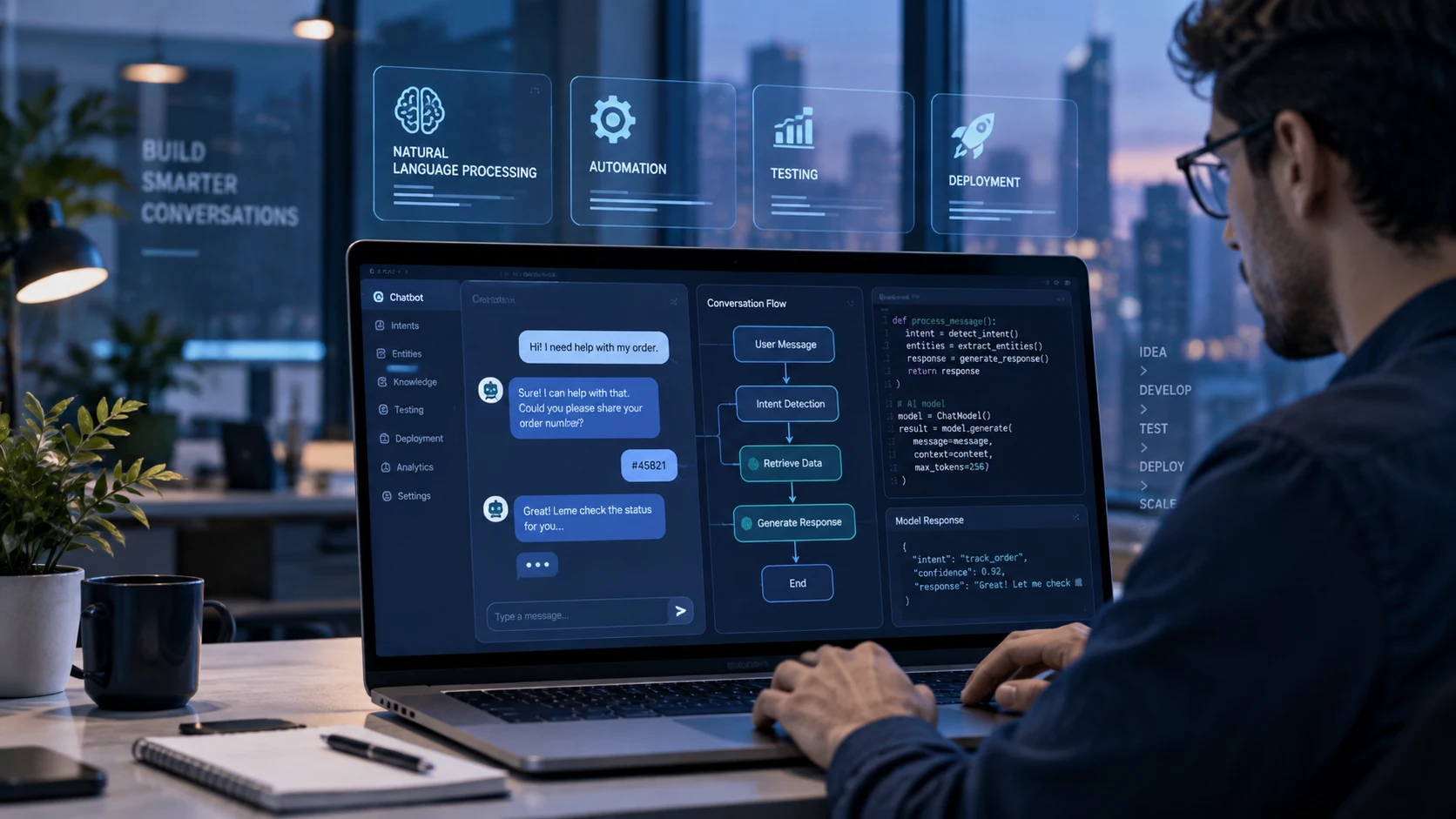
Almost every modern business chatbot runs on an existing large language model, accessed through an API from providers like OpenAI, Anthropic or Google. This keeps upfront costs low. Costs rise when a project needs fine-tuning or a custom model trained on specialist data. If your project leans on a specific provider, you can hire OpenAI and GPT experts or Claude and Anthropic experts who already know that platform's quirks.
2. Your knowledge base
A bot that answers from your help docs, policies, or product catalog needs that content cleaned, organized, and indexed. This setup is called retrieval-augmented generation (RAG). If your content is messy, spread across tools, or out of date, expect data preparation to take a real share of the budget. Developers who work with frameworks like LangChain do this work often, and LangChain developers for RAG chatbots can usually estimate it quickly once they see your data.
3. Integrations
A chatbot that only answers questions is simple. One that looks up orders, creates support tickets or updates your CRM needs custom backend work for each system it touches. Connecting to tools like HubSpot or Salesforce is one of the most common reasons a budget grows mid-project. If your bot needs to log leads or conversations, bringing in HubSpot CRM specialists early saves rework later.
4. Channels
A bot on your website costs less than one that also runs on WhatsApp, Instagram, Slack or phone. Each channel has its own setup, rules and testing needs.
5. Security and compliance
A bot that handles health, financial or personal data needs stronger access controls, logging and data handling. Rules like HIPAA in the US or GDPR in the UK and EU add review and testing time. This is one area where I wouldn't cut corners to save money.
6. Developer location and seniority
Rates for the same skill vary a lot by region. In the US and Canada, AI freelancers often charge $100 to $250 an hour. In Eastern Europe, the range is closer to $40 to $100, and in India and Southeast Asia, $25 to $80. A full breakdown of what it costs to hire an AI freelancer shows how rates change with experience level and project type.
The Ongoing Costs Most Quotes Leave Out
The build price is only part of the budget. These are the costs that keep coming each month.
- AI model usage. You pay the model provider for the text your bot reads and writes, measured in tokens (a token is roughly three-quarters of a word). For example, Anthropic currently lists its lightweight Claude Haiku 4.5 model at $1 per million input tokens and $5 per million output tokens.
- Here's what that means in practice. Say your bot handles 5,000 conversations a month, and each one uses about 2,000 input tokens (including the content it pulls from your knowledge base) and 400 output tokens. That's about $10 for input and $10 for output, or roughly $20 a month. At 50,000 conversations, it's about $200. Larger flagship models cost more per token, so model choice matters as volume grows.
- Hosting and databases. Servers, and the vector database that stores your indexed content, often add $20 to $500 or more a month, depending on traffic and data size.
- Maintenance. Prompts need tuning, content changes and AI models get updated. A common planning rule is to budget 15% to 20% of the build cost each year for maintenance. Freelance maintenance retainers typically run $500 to $3,000 a month for business-critical bots.
- Human handoff. Even a good bot needs a person to handle complex or sensitive conversations. That staff time is a real cost, even though it rarely shows up in a quote.
There is good news on running costs. Stanford HAI's AI Index 2025 found that the cost of running a model at GPT-3.5's level of performance fell more than 280-fold in about 18 months. For most businesses, the model itself is no longer the expensive part. The people, data and integrations are.
What You Get at Three Budget Levels
- Under $2,500. A website bot that answers common questions from your FAQs and policies, captures leads, and hands off to email when it can't help. This is a good first project for small businesses that want to test demand before investing more.
- $2,500 to $15,000. A support bot trained on your full help center, connected to your helpdesk or CRM, with clean handoff to a human agent. This is where most small and mid-sized businesses land. It's also where a bot starts to change how support runs day-to-day. A well-planned 24/7 AI customer service system usually sits in this range.
- $15,000 and up. An assistant that takes actions (processing refunds, booking appointments, updating orders) across several systems, often with compliance requirements. At the enterprise end, with multiple channels and strict governance, agency projects can pass $150,000.
How to Keep Chatbot Costs Under Control
My advice is to start smaller than you think you need. The businesses that overspend usually try to automate everything in version one.
- Pick one job for the bot first. Answering order-status questions or qualifying leads is enough for a first release.
- Use the content you already have. Your FAQs, help articles and policy pages are the cheapest training material available.
- Route simple questions to a lighter model. Save larger, more expensive models for the conversations that need them.
- Launch on one channel. Add WhatsApp or voice after the website bot proves itself.
- Pay by milestone. Fixed-price milestones keep scope creep visible and your budget predictable.
- Write a clear brief before asking for quotes. Vague briefs get padded quotes. A simple structure for writing an AI project brief covers the goal, your data, the systems involved and your budget range.
How to Get an Accurate Chatbot Quote
Ask two or three builders to quote from the same brief, then compare what each quote includes rather than just the total. A good quote should tell you:
- Which AI model they plan to use and why
- How your knowledge base will be prepared and kept up to date
- Which integrations are included and which cost extra
- Expected monthly running costs at your conversation volume
- Who owns the code, prompts and workflows after delivery
- What maintenance looks like after launch
Asking to see a live bot they've built tells you more than any proposal. It's one of the core steps in vetting AI freelancers before you hire.
Frequently Asked Questions
How much does a chatbot cost?
A chatbot costs anywhere from free (on a basic no-code plan) to $500,000 or more for an enterprise AI assistant. Most small and mid-sized businesses pay $1,500 to $15,000 to have a custom AI chatbot built, plus monthly running costs that often start under $100 at low volume.
Can I build my own AI chatbot?
Yes. No-code platforms let you build a basic bot from your website content without writing code. The limits show up when you need integrations with your own systems, custom logic or strict control over data. That's usually the point where hiring a developer pays off.
Can I build my own AI for free?
You can build a simple chatbot for free using the free tiers many platforms offer, but free plans cap usage and features. Building your own AI model from scratch is a different thing entirely, and it's far from free.
How much does it cost to develop ChatGPT?
Far more than any business chatbot. Stanford HAI's AI Index estimated that training GPT-4 took about $78 million worth of computing power, and Google's Gemini Ultra about $191 million. Businesses don't need to spend anything close to this. They rent access to these models through an API and pay per use.
How much does it cost to develop AI?
It depends on what "develop" means. Adding AI to your business through existing models can cost a few thousand dollars. Training a new frontier model costs tens or hundreds of millions. Most business AI projects, chatbots included, sit at the low end because they build on models that already exist.
Why is AI so expensive now?
Training the largest models takes huge amounts of computing power, which is why frontier AI costs so much to build. Using AI, though, is getting much cheaper. Stanford's AI Index found that running a model at GPT-3.5's level of performance fell more than 280-fold in cost in about 18 months. For a business, most of the cost is now skilled labor, data preparation and integrations.
How long does it take to build a chatbot?
A basic FAQ bot can be ready in one to two weeks. A chatbot trained on your knowledge base usually takes three to eight weeks. Agentic assistants and enterprise builds can take several months.
Is it cheaper to use a chatbot platform or build a custom one?
At low volume, a platform is usually cheaper and faster. Custom builds make more sense when you need deep integrations, full data control or high conversation volume, where platform fees add up.
Final Thoughts
Chatbot development cost in 2026 depends less on AI itself and more on scope: what the bot needs to know, which systems it connects to and who builds it. Start with one clear job, get quotes from the same brief, and plan for monthly running costs from day one.
If you want to compare vetted builders for your project, you can browse specialists who build conversational AI and chatbots and see their past work before you reach out. If you'd rather not manage the build yourself, Botpool One, the fully managed AI build service, handles delivery end to end.
