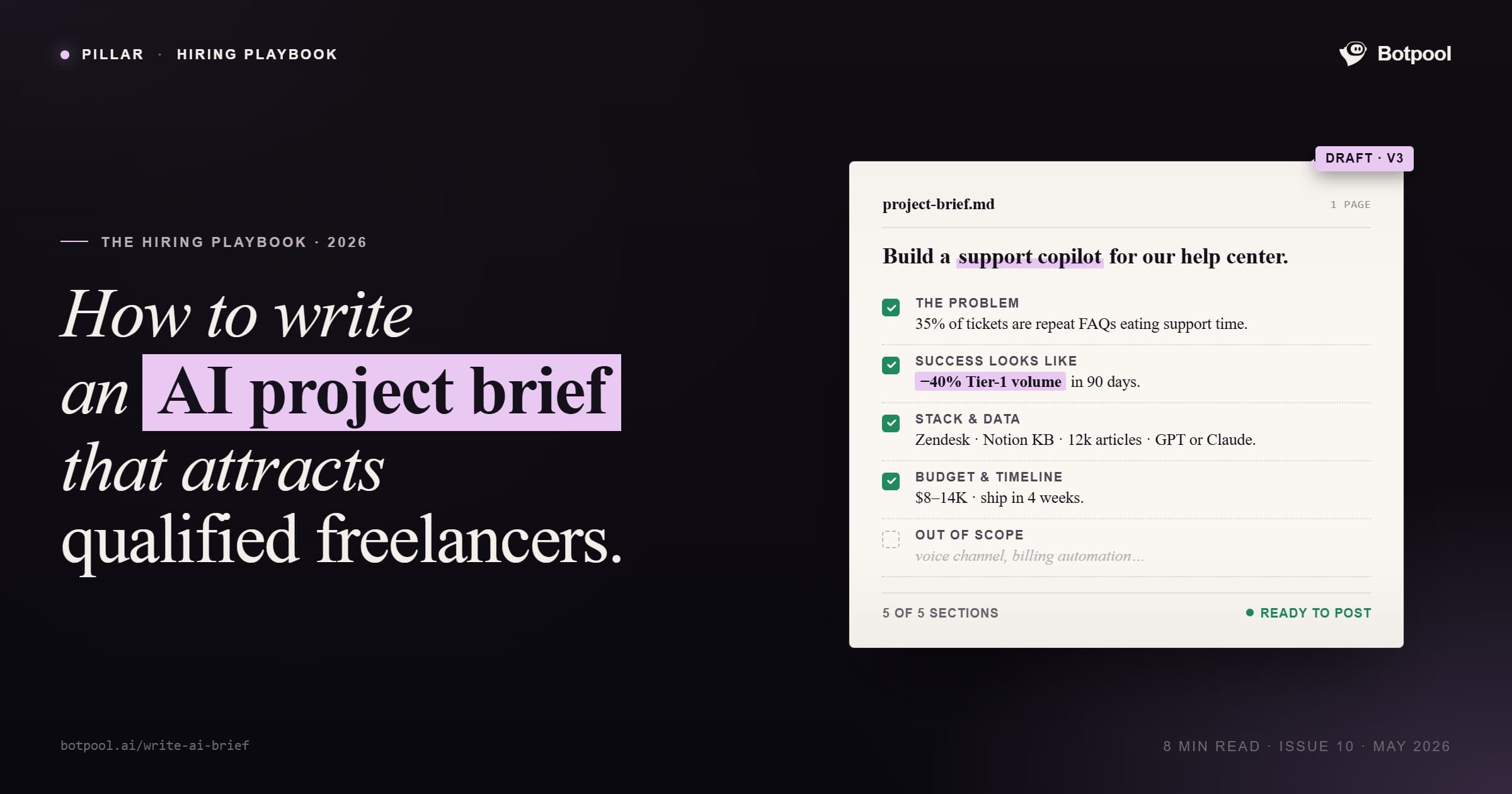

A strong AI project brief makes the difference between hiring the right specialist in days or wading through generic proposals for weeks. The best briefs spell out the problem, the technical scope, the data you have, the budget range, and how success will be measured. Anything less invites vague proposals from freelancers who are not the right fit. This guide walks through exactly what to include, with a copy-ready template at the end.
Why Does Your AI Project Brief Matter So Much?
A vague brief gets vague proposals. Specialists with real production experience either skip projects they cannot scope properly or pad their prices to cover the unknowns.
Clear briefs do three things at once. They attract qualified freelancers, filter out unqualified ones, and give you accurate quotes you can actually compare.
The good news is that writing one well takes about 30 minutes if you know what to include.
What Should an AI Project Brief Include?
Eight sections cover almost every AI project. Use them in this order.
- Project overview and business goal
- The problem you are trying to solve
- Scope and deliverables
- Technical requirements and tech stack
- Data sources and infrastructure
- Success metrics
- Budget, timeline, and communication
- How to apply
Each section answers a question every qualified freelancer will ask before they accept the project.
How Do You Write Each Section of the Brief?
1. Project Overview and Business Goal
One or two sentences. What are you building, and why does the business need it?
Example: "We want to build an AI chatbot for our SaaS support team to handle Tier 1 customer questions automatically and reduce our 24-hour response time."
Skip the buzzwords. Plain language wins here.
2. The Problem You Are Trying to Solve
Describe the pain point in real terms. Numbers help.
Example: "Our 3-person support team handles 800 tickets per week. About 60% are repetitive questions about pricing, onboarding, and integrations. Response times average 18 hours, and customer satisfaction is dropping."
This tells the freelancer the actual goal, not just the surface ask.
3. Scope and Deliverables
Spell out exactly what you expect to receive when the project is done.
A clear deliverables list looks like this:
- A deployed AI chatbot accessible from our website footer
- Trained on our help center articles and FAQ pages
- Integrated with our existing Zendesk account
- A simple admin panel to update the knowledge base
- Documentation for our internal team
If you are not sure what is realistic, leave a note saying so. Good freelancers will ask follow-up questions.
4. Technical Requirements and Tech Stack
This is the section that filters serious specialists from generalists. Be specific about:
- The type of project (chatbot, voice agent, AI agent, automation, RAG system, fine-tuning, etc.)
- Preferred models or APIs (OpenAI, Claude, Gemini, open-source)
- Required platforms or tools (Zapier, Make, LangChain, Pinecone, Voiceflow, etc.)
- Where the system will be hosted (AWS, Vercel, your existing infrastructure)
- Any integrations needed with existing tools
If you do not know the right tech, that is fine. Write: "We are open to your recommendation. Tell us what you would use and why."
5. Data Sources and Infrastructure
AI projects live or die on data. Cover three things:
- Where the data lives (CRM, helpdesk, PDFs, website, internal databases)
- What state it is in (clean and structured, messy, needs preprocessing)
- Any privacy rules that apply (GDPR, HIPAA, no third-party hosting, etc.)
Even one sentence on each is enough. Specialists know what to do with the information once they have it.
6. Success Metrics
How will you know the project worked? Pick 2 or 3 measurable outcomes.
Examples:
- AI handles at least 60% of incoming Tier 1 tickets without human help
- Average response time drops below 2 minutes
- Customer satisfaction score stays above 4.2 out of 5
Avoid metrics you cannot actually measure. Vague success criteria lead to disputes later.
7. Budget, Timeline, and Communication
This section saves everyone time. Three short answers:
Detail | What to Include |
|---|---|
Budget | A fixed price range or hourly rate band |
Timeline | Target start date, target completion date, and any hard milestones |
Communication | Preferred channels (Slack, email, video calls) and update cadence (daily, weekly) |
If you are not ready to commit to a budget, give a range like "$2,000 to $5,000" rather than leaving it blank. Open-ended budgets attract proposals at every extreme.
8. How to Apply
End the brief with a clear instruction that filters out automated or templated proposals.
Examples:
- "Please share 2 links to similar AI chatbots you have built."
- "Start your proposal with the word 'banana' so we know you read this brief."
- "Tell us in 1 paragraph how you would approach the data preprocessing step."
This one trick alone removes 60 to 80% of low-effort applications.
What Are the Most Common Mistakes in AI Project Briefs?
A few patterns show up in nearly every weak brief. Avoiding them moves you ahead of most clients posting on freelance platforms.
- Being too vague about the scope. "Build us an AI tool" attracts generic proposals.
- Hiding the budget. Freelancers assume the worst and either inflate or skip.
- Skipping the data section. Most AI project delays come from messy or missing data.
- No success metrics. Without them, there is no way to declare the project done.
- Asking for everything. A 20-feature MVP brief signals scope creep before the project starts.
A Simple Project Brief Template You Can Copy
Project Title: [Short, clear name]
Overview:
[1-2 sentences about what you are building and why]
The Problem:
[Specific pain point, with numbers where possible]
Scope & Deliverables:
- [Deliverable 1]
- [Deliverable 2]
- [Deliverable 3]
Technical Requirements:
- Project type: [Chatbot, automation, voice agent, etc.]
- Preferred models: [Or "open to recommendation"]
- Tools or platforms: [List what you already use]
- Hosting: [Where it will run]
- Integrations: [Existing systems to connect with]
Data:
- Sources: [Where the data lives]
- State: [Clean, messy, requires preprocessing]
- Privacy rules: [GDPR, HIPAA, etc.]
Success Metrics:
- [Measurable outcome 1]
- [Measurable outcome 2]
Budget: [Range, fixed price, or hourly band]
Timeline: [Start date and target completion]
Communication: [Channels and cadence]
To Apply:
[Specific instruction that filters automated proposals]
Copy this, fill it in, and you will get sharper proposals than 90% of clients on freelance platforms.
What If You Want to Skip the Manual Work?
If you would rather not write a brief from scratch, Botpool can generate one for you.
Start typing what you need into the search bar on the Botpool homepage (for example, "AI automation" or "voice agent for clinic"). Botpool's AI Matching reads your search and instantly produces a Suggested Project Brief, including:

- A project title and description
- Estimated budget
- Timeline recommendation
- Required scope level (small, medium, large)
- Suggested skills and tags
- Matching subcategories
You can review it, edit any field with the "Edit Brief" button, and post the project directly. The whole flow takes under a minute.
This is useful in two situations: when you know what you want but do not want to write it up, or when you are still exploring and want a starting point you can refine. Either way, you get a brief that follows the structure outlined above without the blank-page problem.
How Long Should an AI Project Brief Be?
A focused brief sits between 300 and 700 words. Long enough to cover all 8 sections, short enough that freelancers will actually read it.
If your brief crosses 1,000 words, you are likely overexplaining. Trim and clarify.
When Should You Ask for Help Writing the Brief?
If you are not technical, scoping AI projects can feel impossible. Two options work well.
You can hire an AI consultant to help define the scope before you post the project. This usually takes 1 to 2 hours and saves weeks of mismatched proposals.
You can also post a short brief and ask freelancers to suggest a more detailed scope as part of their proposal. The strongest applicants will do this naturally.
FAQs
How long should an AI project brief be?
Between 300 and 700 words. Long enough to cover all key sections, short enough that freelancers will read it carefully.
Do I need to know the tech stack before writing the brief?
No. If you are unsure, write "open to recommendation" and ask freelancers to propose the stack as part of their pitch.
Should I share my budget upfront?
Yes. Hiding the budget attracts proposals at every extreme. A clear range gets you closer to qualified, realistic quotes.
What is the biggest mistake in AI project briefs?
Being too vague about scope and deliverables. Vague briefs get generic proposals and rarely lead to good hires.
How do I filter out low-quality proposals?
Add a specific instruction in your "How to Apply" section. Asking for a portfolio link or a one-line answer removes most templated applications.
Can I use AI to help write the brief?
Yes. Tools like ChatGPT and Claude can help you organize your thoughts, but the brief should reflect your real business goals, not generic AI output.
How fast can I get qualified proposals once the brief is posted?
On a vetted platform, qualified proposals usually start arriving within 24 to 72 hours.
Conclusion
Writing a strong AI project brief is the single highest-leverage step in hiring the right freelancer. Spend 30 minutes on it, and you will save weeks of misaligned proposals, rework, and budget conflicts.
The pattern is simple. Be specific about the problem, the scope, the data, the budget, and how to apply. Anything else is filler.
Once your brief is ready, post your project on Botpool and get matched with vetted AI specialists in days, not weeks.
