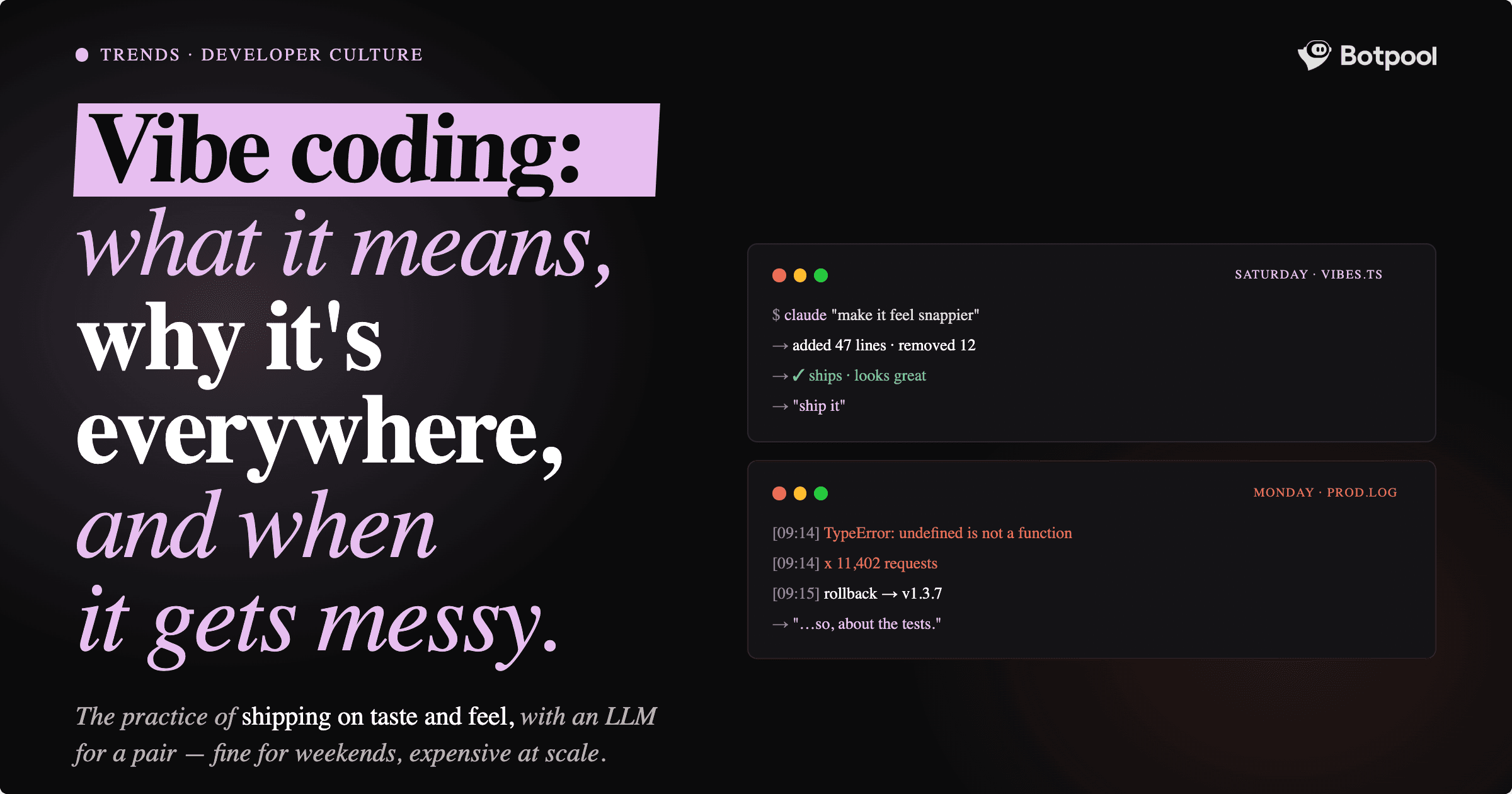

You’ve probably seen people talking about vibe coding lately: a word that’s more than just internet hype. It points to a shift in how developers and non developers are actually building things today leaning heavily on AI, automation, and voice instead of typing every line of code.
It sounds great. It sounds futuristic. But it also brings its own set of problems. Let’s unpack what vibe coding really is, why it’s caught on, and how to handle the downsides.

What is vibe coding?
Vibe coding happens when a programmer or "programmer" enters a description of something they want to create into a code focused large language model (LLM) and allows the AI to generate the software. Instead of actually writing the code, the programmer can easily check, test, and refine what the LLM creates with more text. Theoretically, allows anyone or amateur coders to engage in software engineering without taking years to learn it. In other words, Vibe coding is a relax prompt based approach on based on intuition. In practice, that usually means asking LLMs (Large Language Models) like ChatGPT, Github's CoPilot, or Cursor to write code for you, or finding pre-written code to copy and paste from the world wide web to then tweak it based on instinct and guess until it seems to work. In short, it's coding based on vibes :).
Where Did The Term 'Vibe Coding' Originate?
The term "vibe coding" was first introduced to the world by OpenAI co-founder Andrej Karpathy.
Andrej described it as a "new kind of coding" where he barely touches the keyboard, instead using AI coding assistants like Cursor Composer via voice command. His workflow? "I just see things, say things, run things, and copy-paste things, and it mostly works."

Many users seemed to instantly love the term "Vibe Coding" as it just really sounds cool! Within days of the original Andrej post, memes flooded X and Reddit.
Vibe Coding vs. Traditional Coding
Here’s a quick breakdown of the difference between vibe coding versus normal coding:

When Vibe Coding Gets Messy (and How to Mitigate Risks)
The popular narrative around vibe coding often glosses over serious edge cases and pitfalls. Below are common failure modes and strategies to reduce risk.
Common Pitfalls
Security gaps and vulnerabilities
AI-generated code can miss critical validation, input sanitization, or access controls. Mistakes can lead to data leaks, injection attacks, or privilege escalation.Scalability and performance issues
Generated code may use naive patterns such as repeated database calls or poor caching that won’t survive real traffic.Broken logic or flawed requirements encoding
Ambiguous or incomplete prompts can lead to wrong behaviors or ugly hacks that “feel right” but fail under edge cases.Maintenance burden and technical debt
If you don’t fully understand what the AI generated, future updates, refactoring, or debugging become nightmares.Lock-in and migration difficulties
Some tools generate code tied to their proprietary runtimes or architecture, making export or rewrites painful.Overreliance and complacency
Believing AI can replace skilled human engineers leads to brittle systems or unrealistic expectations.
Future Outlook: Vibe Coding’s Growing Role (and Limits)
Vibe coding is still evolving. As models improve, so will their ability to reason, validate, and handle complexity. But a few trends and cautions will likely persist:
⚡️ AI will get better at verifying its own outputs through integrated test generation and error detection.
⚡️ Hybrid work where AI suggests and humans oversee will remain the safest model for production-scale systems.
⚡️ Regulatory, security, and compliance demands will shape how far AI-generated code can really go without human review.
⚡️ Tools that make code explainable, auditable, and modular will win. Black-box generation won’t cut it for serious applications.
In short, vibe coding is a powerful tool in your toolkit, not a silver bullet. Use it smartly, combine it with human engineering rigor, and you’ll get the speed benefits without sacrificing quality.
