How to Write a Botpool Profile That Gets You Hired: A Freelancer Playbook
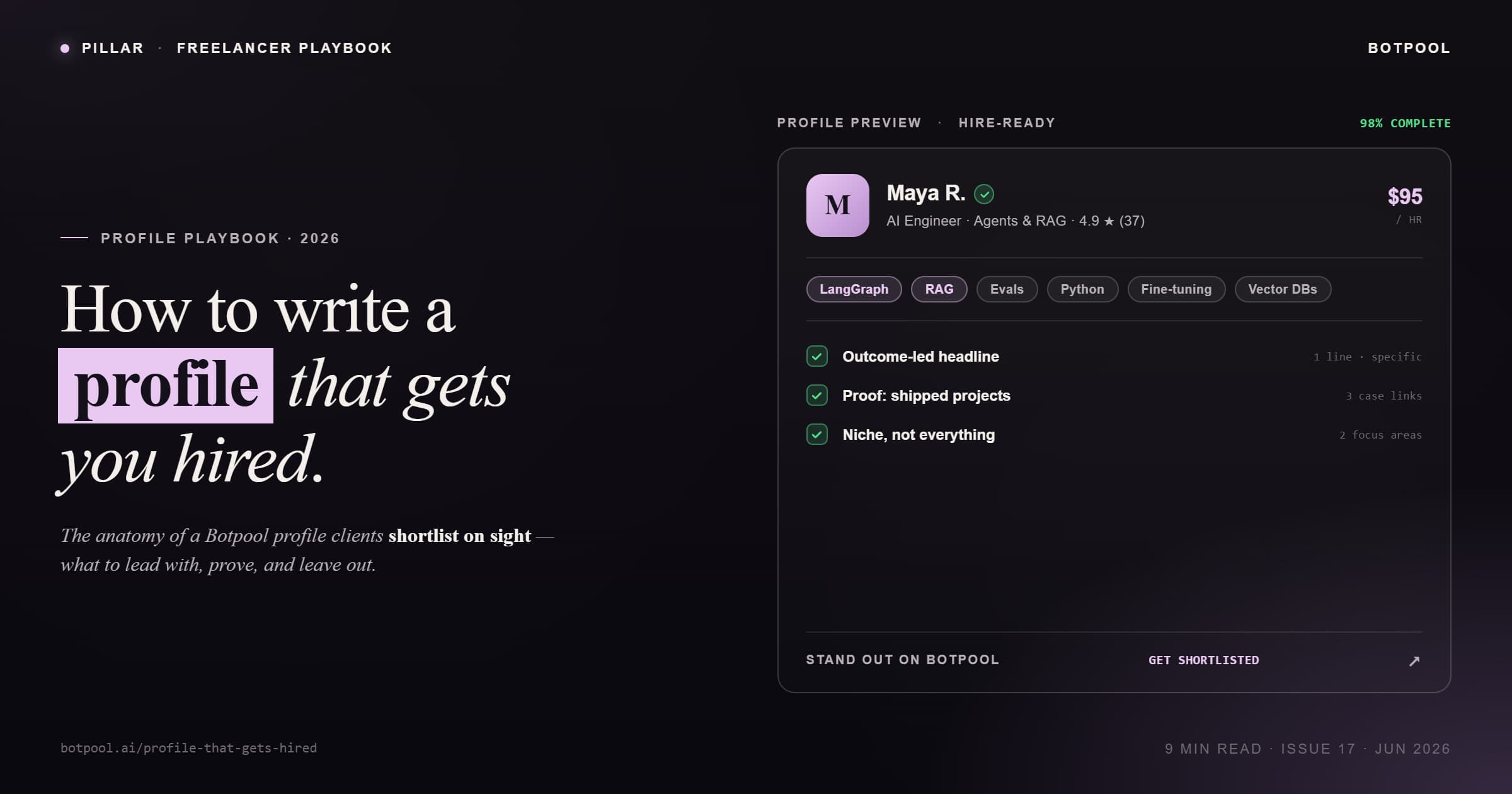

A Botpool profile that gets hired focuses on one niche, shows real proof of work, and matches the exact buyer language clients search for. Profiles that try to do everything (chatbot dev, SEO, plus mobile apps) rarely get clicked. Profiles with a clear AI specialty, 2 to 4 focused services, a portfolio with real case studies, and a structured biography convert 3 to 5 times more. This guide walks through every section of your Botpool profile, what to fix, and what makes the difference between getting hired and getting ignored.
Why Most Botpool Profiles Don't Get Hired
Most underperforming profiles share the same patterns: vague titles, 8+ unrelated services, generic bios, and zero portfolio proof.
Botpool is an AI-focused marketplace. That means clients are searching for specialists, not generalists. A profile listing 10 different skills signals you're not deeply skilled in any of them.
The fix is simpler than most freelancers think. Pick one niche, structure your profile around it, and prove it with real work.
What Sections of Your Botpool Profile Matter Most?
Your Botpool profile has 9 sections. Not all are equally important.
Section | Importance | What It Decides |
|---|---|---|
Profile Photo + Title | Critical | Whether they click on you from search results |
Services / Gigs | Critical | Whether they convert into a hire |
Biography | High | Whether they trust you after clicking |
Portfolio | High | Whether they believe you can do the work |
Specialities + Skills | High | Whether you appear in search results at all |
Work Experience | Medium | Adds credibility, especially for senior rates |
Hourly Rate | Medium | Filters out misaligned buyers |
Education | Low | Nice to have, not deal-breaking |
Reviews | Critical (over time) | Compounds everything else once you have them |
The next sections cover how to optimize each one for hires, with real examples from Botpool profiles that work.
How to Pick Your Niche Before Writing Anything
The single biggest mistake new freelancers make is starting with the profile instead of the niche.
A niche is not "AI development." A niche is "AI chatbots for SaaS support teams" or "SEO and GEO for B2B websites."
The narrower the niche, the higher the rate ceiling and the easier it is to get hired. Generalist freelancers compete on price. Specialists compete on fit.
If you have not picked your niche yet, see our breakdown of the most in-demand AI skills freelancers should learn in 2026, which covers what's growing and where the demand is concentrated.
Once you have the niche, every other section flows from it.
How to Write Your Profile Title and Photo
This is the first thing buyers see in search results. It decides whether they click.
1. The Photo
Use a clear, professional headshot. Plain background, good lighting, real face visible.
Skip cartoons, AI avatars, and stock photos. Real humans hire from people who look real. A simple LinkedIn-style headshot outperforms anything else.
2. The Title
Your title sits right under your name. It's the single most important piece of copy on your profile.
Weak titles (avoid):
- "Computer Science, Automation"
- "AI Developer"
- "Full-Stack Developer"
- "Freelancer"
Strong titles (use this pattern):
- "SEO & AEO Specialist"
- "AI Chatbot Developer for SaaS"
- "Voice AI Engineer (Vapi & Retell)"
- "Shopify AI Automation Expert"
- "Generative AI Consultant for SMBs"
The pattern: specific role + tools or niche. This tells the buyer exactly what you do in 3 to 5 words.
How to Write a Biography That Converts
Your biography is where buyers decide whether to message you. Most are too long, too generic, or both.
A high-converting bio has 3 parts.
Part 1: One-line value proposition
Open with who you are, what you do, and the outcome you deliver. One line, no preamble.
Example: "I'm an SEO & AEO Specialist with 4+ years helping brands grow organic traffic, improve search rankings, and stay visible in both traditional and AI-powered search."
Part 2: Who you've worked with and what results you've delivered
Two to three lines on industries, project types, and outcomes. Specifics build trust.
Example: "I've worked with businesses across e-commerce, telecom, local services, and B2C to deliver real, measurable results. My approach combines technical precision with smart content strategy to build long-term search visibility."
Part 3: A clear "What I can do for you" list
End with 4 to 6 bullet points of specific deliverables. Make it easy for the buyer to imagine the project.
Example:
- Full technical SEO audits (crawling, indexing, site speed, schema)
- On-page optimization aligned with search intent
- Answer Engine Optimization (AEO) for AI search visibility
- Semantic SEO and topical cluster architecture
- Local SEO and Google Business Profile optimization
This structure works because it answers the buyer's three real questions: who are you, can you do this, and what exactly will I get.
How to Build Services That Get Bought
Services (gigs) are your conversion mechanism. Most freelancers post too many, with titles too generic.
The Three Rules for High-Converting Services
1. Focus on volume. Two to four focused services beat 10 scattered ones. Each service should reinforce your niche.
2. Use outcome-driven titles. "I will grow your organic traffic with SEO" works better than "I will do SEO for your website."
3. Match Botpool's category structure. Botpool surfaces services by category. Make sure each service is tagged correctly.
Bad vs Good Service Catalogs
Pattern | Example |
|---|---|
Scattered (bad) | n8n automation + Lovable bug fixes + Voice agents + SEO package + Chatbot dev |
Focused (good) | Monthly SEO Management + GEO Optimization (just SEO-related services) |
Focused (good) | Voice agent build + Voice agent monthly maintenance (just voice AI services) |
Focused (good) | Chatbot MVP + Chatbot RAG integration + Monthly chatbot tuning (just chatbot services) |
The scattered profile signals "I'll take anything." The focused ones signal "I'm the specialist for this."
Service Pricing Cues
Price your services so they tell the buyer about scope.
- Low tier ($100 to $500): one-off small projects, fast turnaround
- Mid tier ($500 to $2,000): standard projects with clear deliverables
- High tier ($2,000+): complex or ongoing work
For a full breakdown of how to price AI services, see our guide on how to price your AI freelance services, which covers packages, retainers, and value-based pricing.
How to Set Your Specialities and Skills for Search
This is the section that decides whether you appear in search results at all.
Specialities
Botpool gives you two levels: Development Stacks and Specialities. Both feed Botpool's matching algorithm.
The rule: keep both narrow.
A profile with "Digital Marketing" as the only Development Stack and "SEO" + "GEO" as the only Specialities signals you're a focused specialist. A profile with 5+ Development Stacks signals a generalist.
Skills
Skills are the keyword layer. Match them to what buyers actually search for.
For an AI chatbot developer, strong skills look like:
- OpenAI API
- Anthropic Claude
- LangChain
- RAG (Retrieval-Augmented Generation)
- Voiceflow
- Botpress
- Customer Support Automation
- Vector Databases
Avoid:
- "Programming"
- "Web Development"
- "AI" (too broad)
- "Computer Science"
The narrower and more specific, the better. Botpool's search filters use these tags.
How to Build a Portfolio That Wins Hires
Portfolio is where buyers decide whether you can actually deliver. Most freelancers skip this or use weak proof.
What Works
- Real case studies with before/after metrics ("Nayatel SEO Case Study: 67% Traffic Growth in 6 Months")
- Live project links that the buyer can click and verify
- Branded thumbnails that look professional (not screenshots from your dev environment)
- 3 to 6 projects across different industries or use cases
What Doesn't Work
- Generic stock images with vague descriptions
- Project thumbnails with no client name, results, or context
- Just one piece of work (looks thin)
- Code screenshots without explanation
If you don't have client work yet, build 2 to 3 demo projects with real results. A working chatbot URL is worth more than 10 certificates.
How to Match Your Work Experience to Your Niche
Buyers scan work experience to confirm your background fits your services.
A common mistake: your services say AI chatbot developer, but your work experience shows mobile app development at companies nobody recognizes.
The fix: highlight work experience that reinforces your niche. If your AI experience is limited, lead with the most relevant role first and trim or de-emphasize unrelated roles.
If you have a non-AI background, frame it around transferable skills. A former customer support manager moving into AI support agents has highly relevant context. Say so.
How to Set Your Hourly Rate Strategically
Your hourly rate is a signal as much as a price.
Too low signals a beginner or an inexperienced. Too high signals overpriced if your portfolio doesn't back it up.
Starting ranges for AI freelancers on Botpool:
Experience | Suggested Hourly Range |
|---|---|
New to AI freelancing (0 to 6 months) | $15 to $40 |
Mid-level (6 to 18 months) | $40 to $80 |
Specialist with proven work (1 to 3 years) | $80 to $150 |
Expert with strong portfolio (3+ years) | $150 to $300+ |
Hourly rate works best as a baseline for buyers calibrating your range. The real income comes from packages and retainers, which is covered in detail in the pricing guide linked above.
How to Get Your First Reviews
Reviews are the compounding asset on Botpool. Once you have 3 to 5 real reviews on services, conversion rate increases sharply.
Three ways to get your first reviews fast:
1. Offer a discounted first project. Half-price first delivery in exchange for an honest review. Frame it as "I'm new here building reputation."
2. Convert existing client work onto Botpool. If you already have past clients, ask them to leave a review on Botpool. Send them the direct link.
3. Deliver above scope on your first 3 projects. Slight over-delivery turns 4-star reviews into 5-stars and earns referrals.
Once you cross the 5-review threshold, your profile starts to compound. Each new review reinforces every future hire.
Common Botpool Profile Mistakes
The five mistakes that show up most often:
1. Cartoon avatar or no photo. Cuts your click-through rate in half before the buyer even reads your title.
2. Generic title. "Developer" or "Freelancer" tells the buyer nothing. Specific titles win.
3. Too many services. Five services from five different niches signals scattered. Pick a lane.
4. Empty portfolio. No proof of work makes buyers second-guess everything else in your profile.
5. Mismatched work experience. Your services say AI chatbot developer, but your jobs say SQA Engineer. Buyers notice this.
Fix any one of these and conversion improves. Fix all five and your profile compounds.
FAQs
How many services should I have on my Botpool profile?
Two to four focused services. Each should reinforce your niche. More than five scattered services signals generalist and hurts conversions.
Should I include my photo or use a graphic?
Always use a real, professional photo. Cartoons, AI avatars, and stock photos significantly reduce trust and click-through rate.
What if I'm new to AI freelancing and have no portfolio?
Build 2 to 3 demo projects that show your work. A live chatbot URL, a working automation, or a published case study counts as portfolio. Start small but show something real.
How long should my biography be?
Around 150 to 250 words structured in 3 parts: a one-line value prop, results and industries you've worked with, and a "What I can do for you" list.
Can I switch my niche later if I want?
Yes. Update your title, services, and skills first. Then update the biography and add new portfolio work that fits the new niche. Reviews carry over.
Should my hourly rate match my service prices?
Loosely yes. Your hourly rate should reflect what a buyer would pay for ad-hoc work. Service prices reflect packaged outcomes and can effectively be higher per hour.
Do specialities and skills really affect search visibility?
Yes. Botpool's matching uses these tags to surface freelancers for buyer searches. Choose them carefully to match what buyers in your niche actually search for.
How fast can I expect my first hire on Botpool?
Most well-optimized profiles get their first inquiry within 2 to 6 weeks. Speed depends on niche demand, profile quality, and how active you are with proposals.
Conclusion
The Botpool profiles that get hired share a clear pattern: one narrow niche, real photos, specific titles, focused services, structured bios, and portfolio proof.
Pick your niche first. Build the rest of the profile around it. Show real work, even if you have to create demo projects to start. Get your first 3 to 5 reviews by slightly over-delivering on early projects.
Most freelancers spend their time chasing new clients. The ones who outearn everyone else spend their time making sure their profile sells while they sleep.
If you have not joined yet, sign up on Botpool and start building the profile your future clients can actually find.
