How to Price Your AI Freelance Services: Rates, Packages, and Value-Based Pricing
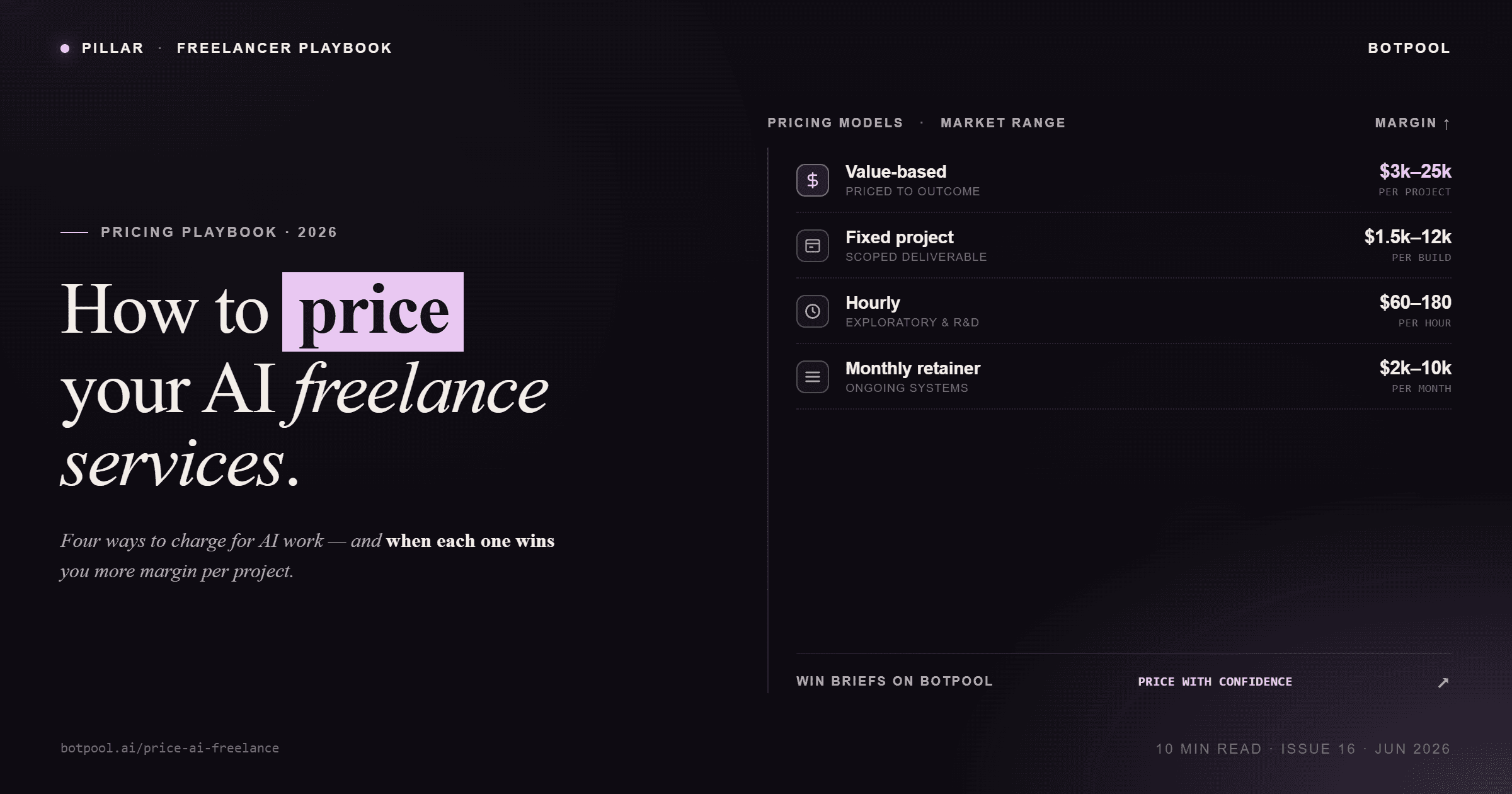

To price your AI freelance services in 2026, move beyond hourly rates and price on the value you deliver. Most AI freelancers earn the most with tiered packages ($500 to $5,000+ per project) plus monthly retainers ($300 to $3,000+) for ongoing maintenance.
Value-based pricing (charging 10 to 20% of the cost savings or revenue gains you generate) earns 2 to 5x more than hourly. This guide breaks down the 5 pricing models, real package examples, retainer structures, and how to price what you build.
Why You Should Stop Pricing AI Work by the Hour
Hourly pricing punishes you for getting better. The faster you ship, the less you earn. That math doesn't work in AI freelancing.
A workflow that took you 20 hours last year now takes 3 hours with better tools. Hourly pricing means you just took an 85% pay cut for the same outcome.
The freelancers earning the most in 2026 price on outcomes, not time. They sell packages, retainers, and value-based pricing tied to client results.
The 5 AI Freelance Pricing Models (and When to Use Each)
Five pricing models cover almost every AI freelance project. Pick based on the type of work, not your comfort level.
Pricing Model | Typical Range | Best For |
|---|---|---|
Hourly | $25 to $250/hr | First 3-5 projects, exploratory work |
Fixed-price project | $300 to $25,000+ | Well-defined one-off builds |
Tiered packages | $500 to $5,000+ | Productized services with clear scope |
Monthly retainer | $300 to $3,000+ | Ongoing maintenance and optimization |
Value-based | 10 to 20% of client ROI | Senior work with measurable outcomes |
Most successful AI freelancers use packages plus retainers as their default. Hourly is the entry point. Value-based is the long game.
How to Build Tiered Packages That Sell Themselves

Tiered packages remove the price negotiation problem. Clients pick a tier instead of haggling line items.
The proven structure is three tiers: Basic, Standard, Premium. Each one bundles deliverables so clients see what they're getting.
Real Example: AI Automation Specialist Packages
Tier | Price | What's Included |
|---|---|---|
Starter | $750 | 1 automation workflow, 2 tool integrations, 30-day support |
Growth | $1,800 | 3 workflows, 5 integrations, custom AI agent setup, 60-day support |
Scale | $4,500 | Full automation system, 10+ integrations, AI agent + dashboard, 90-day support, 1 strategy call/month |
Real Example: AI Chatbot Developer Packages
Tier | Price | What's Included |
|---|---|---|
FAQ Bot | $1,200 | Basic chatbot trained on FAQs, website widget, 1 channel |
Support Bot | $3,500 | Trained on full knowledge base, helpdesk integration (Zendesk/Intercom), 3 channels |
Enterprise Bot | $8,500 | Multi-channel deployment, CRM integration, custom analytics, voice + chat |
The pricing math behind these tiers is simple: the middle tier is the one you actually want most clients to pick. Price the Starter low enough to be safe, the Premium high enough to feel premium, and the middle as the obvious value choice.
How to Price Monthly Retainers for AI Work
Retainers are the most underrated pricing model in AI freelancing. Most clients need ongoing AI work, not one-off builds.
AI systems require regular prompt tuning, model updates, API maintenance, and optimization as your client's data and use case evolve. Retainers turn one-off projects into predictable monthly income.
Typical Retainer Ranges
Retainer Scope | Monthly Range |
|---|---|
Light maintenance (bug fixes, minor updates) | $300 to $800 |
Active optimization (monthly tuning, reporting) | $800 to $2,000 |
Full management (new features, integrations, support) | $2,000 to $5,000+ |
Strategic AI partner (consulting + builds + advice) | $3,000 to $10,000+ |
How to Position a Retainer
Don't pitch maintenance. Pitch results.
- Weak retainer pitch: "I'll handle ongoing chatbot updates for $1,500/month."
- Strong retainer pitch: "I'll maintain and improve your AI support agent so it keeps deflecting 60% of your tickets. $1,500/month, includes monthly performance report and 2 optimization cycles."
The second one ties payment to value, not labor.
How to Use Value-Based Pricing (The Highest-Paid Approach)
Value-based pricing is where senior AI freelancers separate from everyone else. Instead of charging for time, you charge a percentage of the value you create.
The rule of thumb: charge 10 to 20% of the measurable client benefit you generate annually.
Worked Example
Your client runs a 5-person customer support team at $50,000 per person per year ($250,000 total). You build an AI support agent that handles 60% of tickets, allowing them to redeploy 3 people to higher-value work.
- Client savings: $150,000 per year.
- Your fee at 10%: $15,000.
- Your fee at 20%: $30,000.
If you tried to price this hourly at $100/hr, the same build might cap at $5,000 for 50 hours of work. Value-based pricing pays you 3 to 6x more for the same outcome.
Where Value-Based Pricing Works Best
- Cost-saving automation builds (you can calculate savings)
- Revenue-generating AI agents (lead-gen, sales bots)
- Productivity systems (time saved x hourly value)
- Customer retention systems (churn reduction)
For value-based pricing to work, the client outcome has to be measurable. If you can't put a number on it, fall back to packages.
How to Calculate Your Actual Business Costs
Many AI freelancers underprice because they forget the real cost of running an AI project. The headline rate isn't what you actually take home.
Three cost buckets matter:
1. Tool subscriptions. Zapier, Make, n8n, hosting, and monitoring tools. Budget $50 to $300 per month minimum.
2. API and model costs. OpenAI, Claude, Pinecone, ElevenLabs. A busy chatbot can use $100 to $500 per month in API spend.
3. Profit margin. Add 25 to 40% on top of your costs to account for taxes, overhead, downtime, and your specialized expertise.
Example Cost Math for a $2,000 Chatbot Build
Cost Item | Amount |
|---|---|
Your time (40 hours at internal rate $40) | $1,600 |
Tools used during build | $80 |
API testing costs | $50 |
Profit margin (25%) | $445 |
Minimum price | $2,175 |
If you quoted $2,000 for this project, you'd actually be losing money. Always run the numbers before quoting.
For a broader context on how cost factors break down across AI projects, see our guide on how much it costs to hire an AI freelancer in 2026, which shows the full pricing breakdown from the client's side.
How to Decide Your Starting Rate
For your first 3 to 5 projects, hourly pricing is fine. Use it to learn the market and build a portfolio. After that, move to packages.
Here is a starting rate guide by experience level.
Experience | Hourly Rate | Project Range |
|---|---|---|
Beginner (first 3 projects) | $25 to $50 | $300 to $1,500 |
Intermediate (3 to 12 months) | $50 to $100 | $1,500 to $5,000 |
Senior (1 to 3 years) | $100 to $200 | $5,000 to $25,000 |
Expert (3+ years, specialized) | $200 to $350+ | $25,000+ |
Rates in 2026 are climbing across all tiers because demand for AI freelance skills grew 109% year over year per Upwork's 2026 data. If you're at the same rate you were 12 months ago, you're underpricing.
Common AI Freelance Pricing Mistakes
Five mistakes show up across nearly every underpaid AI freelancer.
1. Pricing by hour instead of outcome. The faster you get, the less you earn. Bad math.
2. Skipping the discovery call. A 20-minute scoping call lets you price on value, not guess.
3. Quoting the lowest tier first. Anchor with your top package. Most clients will land on the middle tier.
4. Forgetting API and tool costs. A "good" $2,000 project becomes a $500 project after costs.
5. No retainer offering. One-off pricing leaves long-term revenue on the table.
Avoid these, and you'll outperform 80% of AI freelancers competing for the same projects.
How to Position Yourself for Higher Rates
The fastest way to charge more is to specialize. Generic AI freelancers compete on price; specialists who niche into specific industries or use cases command premium rates. botpool
Examples that work:
- "AI workflow automation for Shopify stores"
- "AI customer support agents for SaaS companies"
- "AI lead generation systems for B2B agencies"
- "AI content systems for healthcare brands"
Niche freelancers earn 30 to 50% more than generalists doing the same work. The narrower the niche, the higher the rate ceiling.
If you're still picking which AI skill to specialize in, our guide on the most in-demand AI skills freelancers should learn in 2026 breaks down where the demand is concentrated.
How to Raise Your Rates Over Time
Rate increases are not optional. As your skill, portfolio, and client list grow, your prices need to keep up.
Three rules for raising rates without losing clients.
1. Raise rates for new clients first. Don't increase rates on existing engagements until renewal.
2. Raise rates every 3 to 6 months in your first year. Each completed project should unlock a 10 to 20% rate bump.
3. Communicate the why. Frame rate increases around new capabilities, certifications, or case studies, not arbitrary timing.
A simple notice works: "Starting Q3, new projects will be priced at the updated rate. Existing engagements stay locked in until renewal."
How to Get Paid: Engagement and Payment Terms
Pricing only works if you actually collect. Set clean payment terms upfront.
Payment Term | When to Use |
|---|---|
50% upfront, 50% on delivery | Standard fixed-price projects |
30/30/40 split | Larger builds over 4+ weeks |
Monthly invoicing | Retainers, ongoing work |
Milestone-based | Multi-phase builds |
Pay-on-approval (escrow) | New clients on marketplaces |
For new clients you don't know, never start work without payment in escrow or at least 50% upfront. Marketplace platforms handle this automatically.
To write a brief that produces accurate quotes (and saves you from underpricing), see our guide on how to write an AI project brief that attracts qualified freelancers.
Pros and Cons of Each Pricing Approach
Hourly Pricing
- Pros: Simple, low risk for first projects, easy to invoice
- Cons: Punishes efficiency, low income ceiling, hard to scale
Tiered Packages
- Pros: Removes price negotiation, increases average deal size, scalable
- Cons: Requires productized service, takes work to build correctly
Monthly Retainers
- Pros: Predictable income, deeper client relationships, compounds
- Cons: Requires ongoing service capability, churn risk
Value-Based Pricing
- Pros: Highest earnings, aligns you with client outcomes
- Cons: Requires measurable ROI, senior-level positioning needed
FAQs
How much should I charge as a new AI freelancer?
Start at $25 to $50 per hour for your first 3 to 5 projects. Switch to fixed-price packages between $300 and $1,500 once you have portfolio work.
Is value-based pricing realistic for AI freelance work?
Yes, when the client outcome is measurable. AI automation, support agents, and lead-gen systems all have clear ROI numbers you can price against.
Should I offer a retainer or just sell projects?
Both. Most AI systems need ongoing tuning, so offering a retainer after the project closes captures recurring revenue that one-off pricing leaves behind.
How do I justify charging more than other AI freelancers?
Specialize. Generic "AI freelancers" compete on price. Niche specialists (industry-specific or use-case-specific) command 30 to 50% higher rates for the same skill.
How do I price an AI chatbot build?
Simple FAQ chatbots: $500 to $2,500. Multi-channel chatbots with CRM integration: $3,000 to $15,000. Enterprise chatbots with custom analytics: $8,500+.
What is a fair monthly retainer for ongoing AI maintenance?
Light maintenance starts at $300 to $800 per month. Active optimization with reporting runs $800 to $2,000. Full management with new features runs $2,000 to $5,000+.
How do I handle scope creep without losing the client?
Define what is and isn't included upfront in the package. When clients ask for additions, quote them as add-ons or upgrades to the next tier, not freebies.
When should I raise my rates?
Every 3 to 6 months in your first year. Each project completed and case study added is a signal to bump rates 10 to 20% for new clients.
Conclusion
The fastest way to earn more as an AI freelancer is to stop selling time. Sell outcomes.
Build tiered packages so clients pick a price instead of negotiating one. Add retainers so ongoing work pays you monthly. Move to value-based pricing as soon as the outcomes you create become measurable.
Specialize, document your wins, and raise your rates every 3 to 6 months. The math of AI freelancing rewards builders who price on value, not hours.
If you are ready to start applying these pricing models to real clients, join Botpool as a vetted AI freelancer and get matched with clients hiring at the rates you actually want.
