
Published on
Most teams start this decision with a rate sheet. They see $40 an hour in one region and $150 in another, and the choice looks obvious. Then the first AI project runs two months late because a scoping question took three days to answer each time it came up.
Location does affect cost, but for AI work it affects speed and risk more. In this guide, I compare nearshore and offshore AI development on all three, and give you a way to decide that doesn't depend on hourly rates alone.
Quick definitions: Nearshore development means hiring a team or specialist in a nearby country with a similar time zone. Offshore development means hiring in a distant country, usually with a gap of eight hours or more. Onshore means hiring in your own country. The labels are relative to where you are, so the same developer in Poland is nearshore to a London company and offshore to one in Los Angeles.
Nearshore vs Offshore: What Each One Means in Practice
- For a US or Canadian company, nearshore usually means Mexico, Colombia, Brazil, Argentina, Costa Rica, or Canada. Offshore usually means India, Pakistan, the Philippines, Vietnam, or Eastern Europe.
- For a UK or European company, nearshore usually means Poland, Romania, Portugal, Spain, Ukraine, or Turkey. Offshore usually means South Asia, Southeast Asia or Latin America.
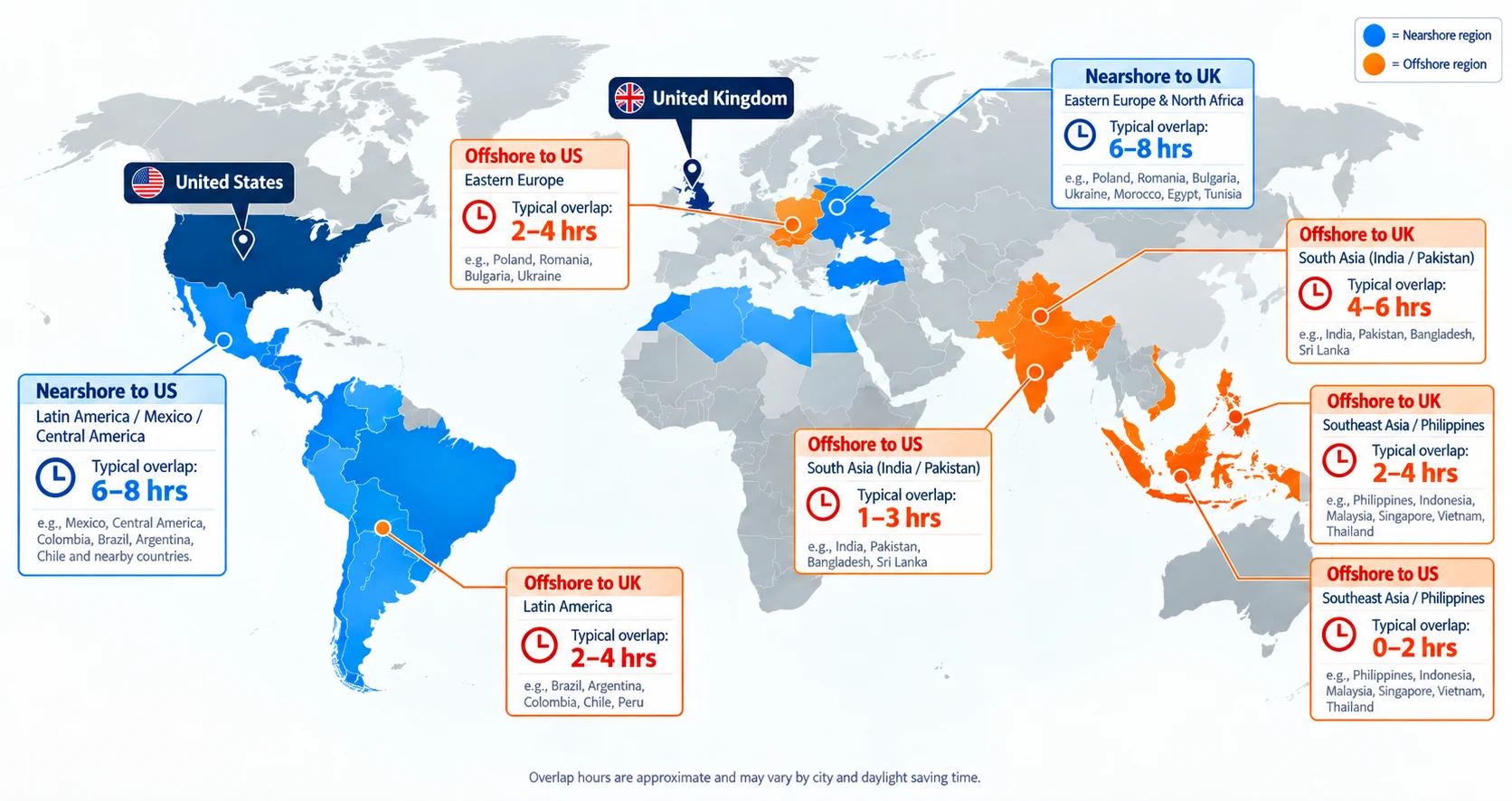
One thing worth clearing up: nearshore and offshore describe where someone works, not how you engage them. You can hire nearshore or offshore through an agency, through a staffing firm, or directly as a freelancer. Those are separate decisions, and the trade-offs of working with a freelancer or an agency on AI projects apply either way.
Nearshore vs Offshore AI Development Compared
Factor | Nearshore | Offshore |
|---|---|---|
Hourly rates | Moderate. Lower than onshore, higher than most offshore markets | Usually the lowest available |
Time zone overlap | 4 to 8 hours of shared working time | 0 to 4 hours, often outside normal hours |
Communication speed | Same-day answers, live calls are easy | Answers often take a full cycle, one exchange per day |
Talent pool | Smaller, regional | Very large, with deep AI and data engineering pools |
Best suited to | Evolving scope, discovery work, frequent feedback | Well-defined builds, steady workloads, overnight delivery |
Main risk | Paying more without using the overlap you paid for | Slow feedback loops and rework on unclear requirements |
Compliance planning | Simpler within one economic bloc | Needs a deliberate data transfer plan |
Cost: Why the Cheapest Rate Is Not the Cheapest Project
Rates vary widely by region. AI specialists in the US and Canada often charge $100 to $250 an hour, Western Europe sits around $80 to $200, Eastern Europe and Latin America around $40 to $120, and South and Southeast Asia around $25 to $80. A fuller breakdown of AI freelancer rates by region and seniority shows how those bands shift with experience level.
Those gaps are real, but a rate is not a cost. The cost of an AI project is the rate multiplied by the hours it actually takes, plus your own team's time spent managing it, plus rework.
Three things quietly close the gap:
- Rework. AI projects involve judgment calls about data quality, edge cases and acceptable accuracy. Every judgment call answered wrongly costs hours.
- Your management time. If your product manager spends six hours a week clarifying requirements, that is a real cost even though it never appears on an invoice.
- Seniority mismatch. A cheaper junior developer on a retrieval or evaluation problem often takes three times longer than a senior one, which erases the saving.
Where offshore genuinely wins on cost is repeatable, well-specified work: data labeling, model evaluation runs, integration work against a documented API, content pipelines, maintenance. Where it can get expensive is exploratory work where nobody yet knows what "done" looks like.
Speed: Time Zone Overlap Matters More for AI Than for Standard Software
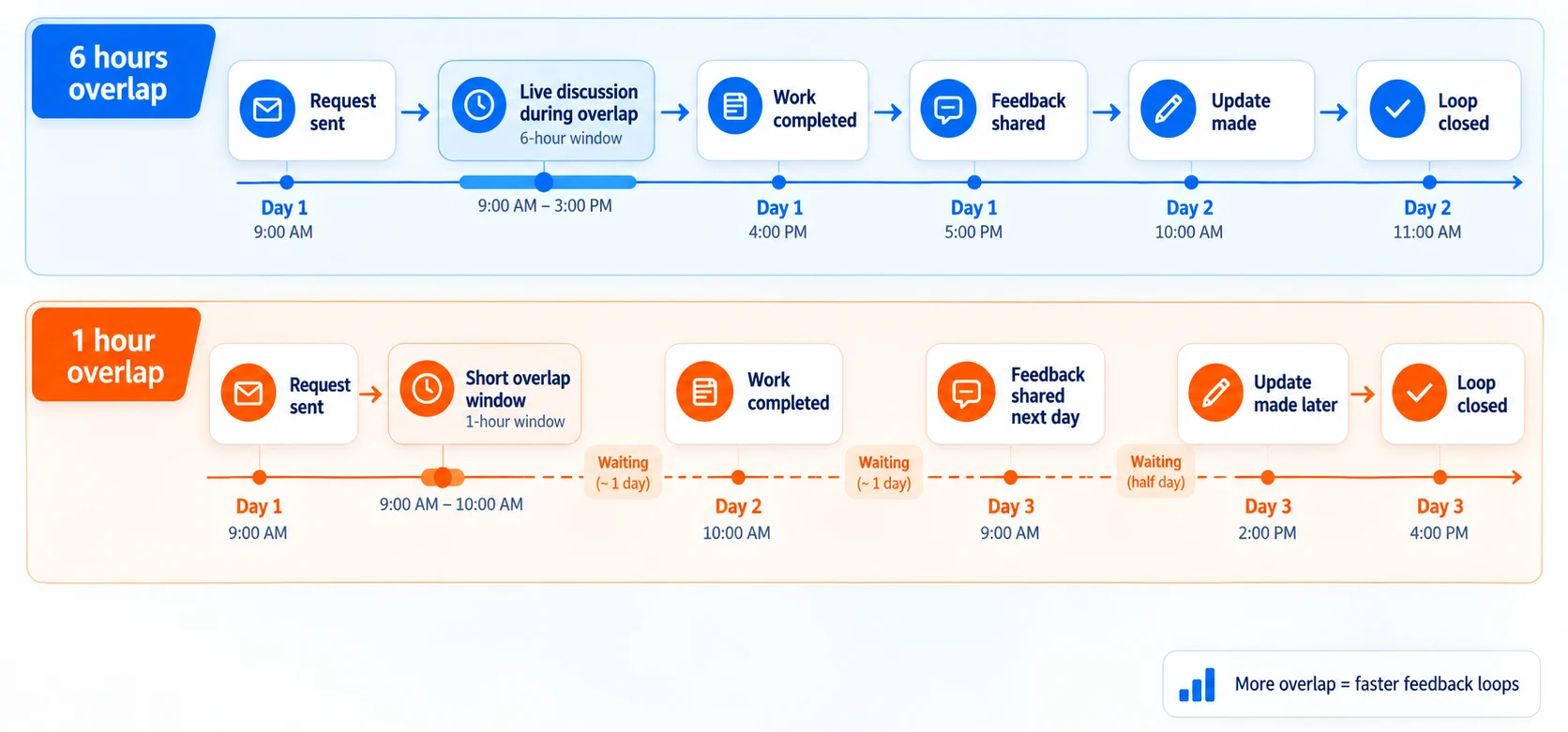
Standard software development can run on written specs. AI work is different because it is iterative by nature. You test prompts, review outputs, argue about whether an answer is good enough, adjust the retrieval setup, and test again. Each loop needs a decision from someone on your side.
With four or more hours of daily overlap, a loop can close in a single day. With one hour of overlap, or none, it often takes two. Over a ten-week project, that difference compounds.
Offshore has a speed advantage too, and it is often overlooked. With a clear backlog, an offshore team can work while you sleep, so you review completed work each morning. That "follow the sun" pattern works well when the scope is stable and the handoffs are written down properly.
My rule of thumb:
- Discovery, prototyping or anything with unclear requirements goes to whoever you can talk to live. Usually nearshore or onshore.
- Execution against a settled plan works well offshore, sometimes faster than nearshore because of the overnight cycle.
This is also why the quality of your brief matters more offshore than nearshore. A clear AI project brief that sets out the goal, data and success criteria removes most of the questions that would otherwise wait 20 hours for an answer.
Risk: Data, IP and Compliance
This is the part most comparisons skip, and it is where AI projects differ from ordinary outsourcing. AI work usually involves your data, and sometimes your customers' data.
Data protection and cross-border transfers
If you handle personal data from the EU, EEA or UK, sending it to a developer abroad is a regulated transfer. The European Commission can issue an adequacy decision for a country, which lets personal data flow there without extra safeguards. Where no adequacy decision exists, transfers need other mechanisms such as standard contractual clauses.
In plain terms: hiring a developer in a country with adequacy is administratively simpler than hiring in one without. It does not make the second option wrong, it just means the paperwork has to exist before the work starts, not after.
A practical workaround that helps in both cases is to avoid sending real customer data at all. Anonymized or synthetic test data is enough for most build and evaluation work.
Third-party AI risk
Bringing in outside help means outside code, outside models and outside tooling in your stack. NIST's AI Risk Management Framework treats this directly, with a governance point covering risks that arise from third-party software, data and other supply chain issues. You don't need a formal program to apply the idea. Ask which models, APIs and libraries a developer plans to use, where your data goes during development, and who holds the API keys.
IP ownership
Put ownership in writing before work begins, and be specific about AI projects: the code, the prompts, any fine-tuned model weights, the evaluation datasets and the documentation. Enforcing a contract across borders is slow and expensive anywhere, so the practical protections are structural rather than legal. Use escrow or milestone payments, keep the repository and cloud accounts in your own name, and ask for regular commits instead of one delivery at the end.
Continuity
A single contractor abroad who disappears leaves you with undocumented prompts and half-configured infrastructure. Ask for documentation as a deliverable in each milestone rather than as a final step, whichever region you hire in.
Which Model Fits Your Project? Five Questions
- How settled is the scope? Clear and stable favors offshore. Exploratory favors nearshore.
- How often do you need live decisions? Daily feedback needs overlap hours. Weekly reviews don't.
- What data will the developer touch? Real personal data raises the compliance bar. Synthetic or anonymized data lowers it.
- Who manages the work? If nobody on your side has time to manage, either hire managed delivery or accept slower progress.
- Is this a one-off build or an ongoing system? Ongoing systems need maintenance cover, which favors whoever you can retain long-term.
If three or more answers point to live collaboration, pay for the overlap. If most point to steady execution, offshore is usually the better value.
A Practical Middle Path
The nearshore versus offshore framing assumes you must choose one location for the whole project. In practice, most AI projects have two very different halves.
The first half is decisions: what the system should do, what data it uses, how you will measure whether it works. The second half is building and maintaining it.
A common split that works well is a senior specialist with good overlap hours for architecture and review, plus offshore capacity for implementation, testing and ongoing maintenance. You pay the premium only for the hours where it changes the outcome.
There is also a third option worth considering before you commit to a region at all. On a vetted marketplace, geography stops being the main filter. You can hire AI developers and engineers with production experience by the skills the project needs, in whichever time zone suits the work, with escrow and standard terms handling some of the risk that a cross-border contract would otherwise carry. For workflow projects specifically, specialists in AI automation and workflow tools like n8n, Make and Zapier are often a better fit than a general development team.
If you would rather not manage delivery yourself in any time zone, managed AI development through a service such as Botpool One, which handles AI builds end to end, takes the coordination work off your plate. That is a different decision from location, and worth separating from it.
Common Mistakes I See in This Decision
- Choosing on hourly rate alone. Compare cost per outcome, not per hour.
- Hiring offshore with a vague brief. The less overlap you have, the more precise your brief needs to be.
- Skipping the vetting step to save a week. Screening portfolios, test tasks and references is the same work wherever the person sits, and vetting AI freelancers properly still costs less than restarting a build.
- Sending production data into a test environment. Use anonymized data until the security setup is agreed.
- Assuming a big rate gap means a big skill gap. It usually reflects local cost of living more than capability.
- Hiring the wrong specialist entirely. A machine learning engineer and an automation specialist solve different problems. Our breakdown of which AI specialist your project actually needs helps if the roles blur together.
Frequently Asked Questions
What is the difference between nearshore and offshore development?
Nearshore development means hiring in a nearby country with a similar time zone, usually within four to eight hours of overlap. Offshore means hiring in a distant country, often with little or no overlap in working hours. Nearshore favors collaboration, offshore favors cost and scale.
Is offshore AI development cheaper than nearshore?
Usually on an hourly basis, yes. Offshore rates for AI specialists often run $25 to $80 an hour compared with $40 to $120 nearshore. Whether the project ends up cheaper depends on how clearly it is scoped, since rework and management time can close the gap.
Is nearshore development better for AI projects?
It is better for AI work that needs frequent feedback, such as prototyping, prompt and retrieval tuning, or anything with unsettled requirements. For well-defined builds, data work and maintenance, offshore often delivers the same result for less.
What are the biggest risks of offshore AI development?
Slow feedback loops, unclear IP ownership, cross-border data transfer rules and weak continuity if a single contractor leaves. All four can be managed with a written brief, a contract that names prompts and model artifacts, anonymized test data, and documentation delivered milestone by milestone.
Can I use both nearshore and offshore talent on one project?
Yes, and it is often the most cost-effective setup. Keep senior review and architecture in a time zone you can reach live, and use offshore capacity for implementation, testing and maintenance.
Does hiring on a freelance marketplace change this decision?
It changes the shape of it. A marketplace lets you select by skill and availability rather than by region, and it standardizes payment protection and terms. You still need to think about overlap hours and data handling, since neither is solved by the platform. A comparison of the best AI freelance platforms in 2026 covers how vetting and fees differ between them.
Final Thoughts
Nearshore and offshore are not good or bad options. They are answers to different questions. Nearshore buys you conversation. Offshore buys you capacity. AI projects need both, usually at different stages.
Before you compare regions, get clear on how settled your scope is, how often you need to make decisions, and what data the work touches. Those three answers will point at a location far more reliably than any rate table.
