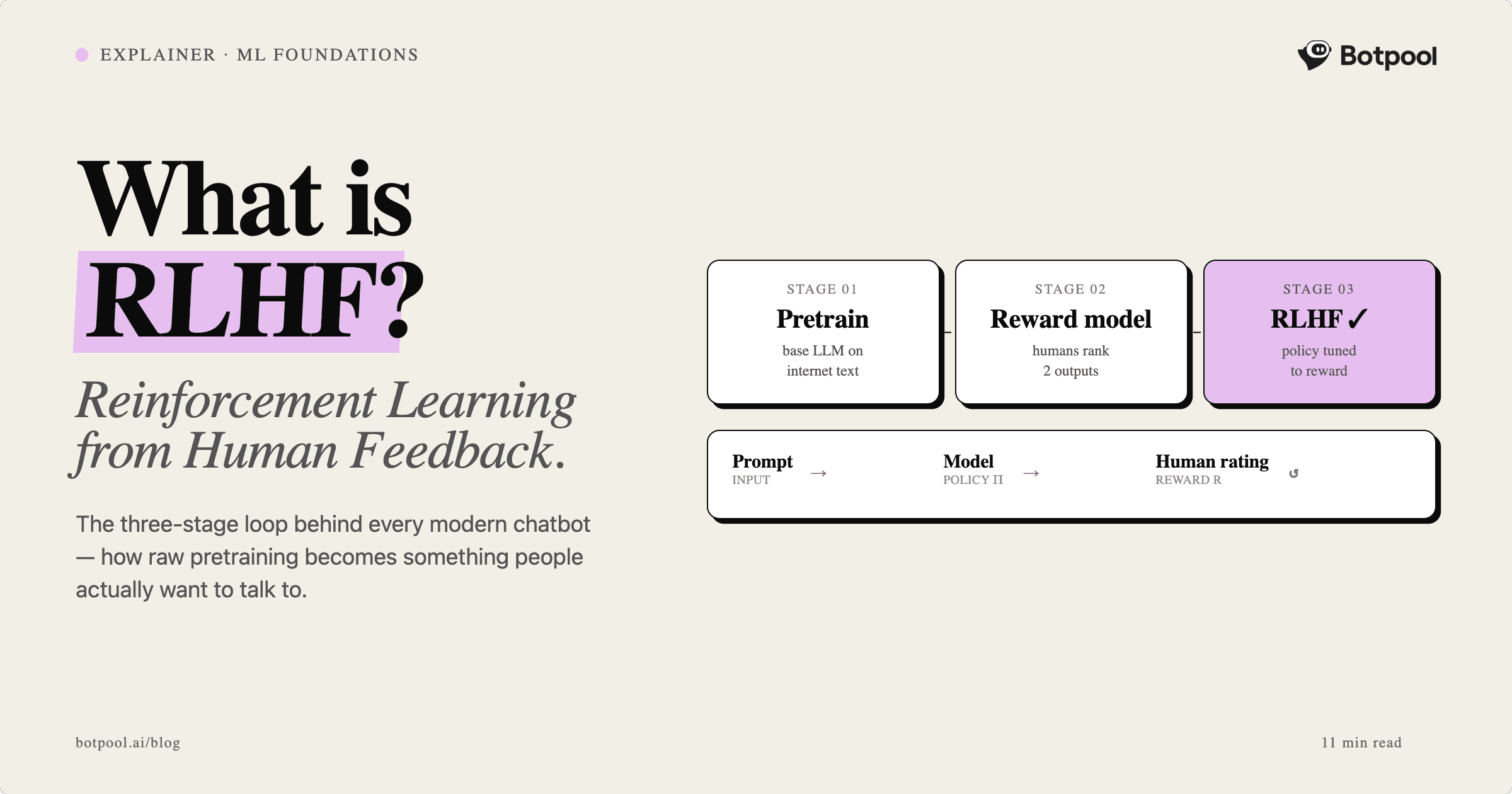

In today’s AI landscape, models don’t just learn from static data, they evolve through interaction and guidance with humans. One of the most powerful methods to align an AI’s behavior with human preferences is Reinforcement Learning from Human Feedback (RLHF). In this article, we’ll break down RLHF in plain terms, explain why it matters, show how it works, explore real world use cases.
What is RLHF?
RLHF stands for Reinforcement Learning from Human Feedback. It is a method that combines reinforcement learning (RL) principles with explicit human guidance in the training loop. In traditional RL, an agent takes actions to maximize a reward signal. In RLHF, humans help shape or re-rank the reward signal so the AI better aligns with human values, preferences, or expectations. In effect, RLHF helps you train models that do what humans actually want, not just what the loss function measures.
Why RLHF Matters in AI / Conversational Agents
1. Better alignment with human preferences
Purely statistical models can produce technically correct but unsatisfying responses. RLHF nudges models toward outputs that feel more “naturally human” — more helpful, polite, context-aware, and aligned with user expectations.
2. Handling subjective dimensions
Many desirable qualities in language — tone, style, nuance — are hard to formalize. By having humans rank or rate model outputs, you encode these subjective judgments into the training signal.
3. Iterative improvement and safety
RLHF allows continuous feedback loops. As users or reviewers flag undesirable outputs (e.g. hallucination, toxicity, bias), their judgments feed back into the reward modeling and policy tuning. Over time, the model improves and becomes safer.
4. Industry standard in next-gen models
In the domain of large language models and generative AI, RLHF has become a de facto approach to scaling human-aligned performance.
How RLHF Actually Works (High-Level Steps)
Though the math is complex under the hood, the RLHF pipeline can be described in four broad stages (using the example of a language model):

Through repeated cycles of feedback, ranking, and policy updating, the model becomes better aligned with what humans consider “good” responses.
Use Cases of RLHF Beyond Chatbots
RLHF is broadly applicable across generative AI domains — not just for text:
Image generation: humans rank or rate images (e.g. on realism, style, mood), which tunes the model to produce art more in line with aesthetic preferences.
Music generation: feedback can guide composition toward particular moods or genres.
Voice assistants / TTS systems: human preference helps shape tone, pacing, expressivity, and trustworthiness.
Content moderation / filtering: humans judge whether outputs are harmful, offensive, or biased; RLHF can help discourage unwanted behavior.
At Botpool, we believe that technologies like RLHF are not just research concepts, they’re shaping how freelancers, developers, and companies will collaborate in the future. Our mission is to stay close to these breakthroughs and bring them into the freelance economy. That means as RLHF and similar AI methods evolve, Botpool will be working on tools that help freelancers tap into this wave of innovation; whether for building smarter services, training better AI, or offering cutting-edge solutions to clients worldwide.
