How to Grow as an AI Freelancer in 2026: Skills, Positioning, and Platform Success
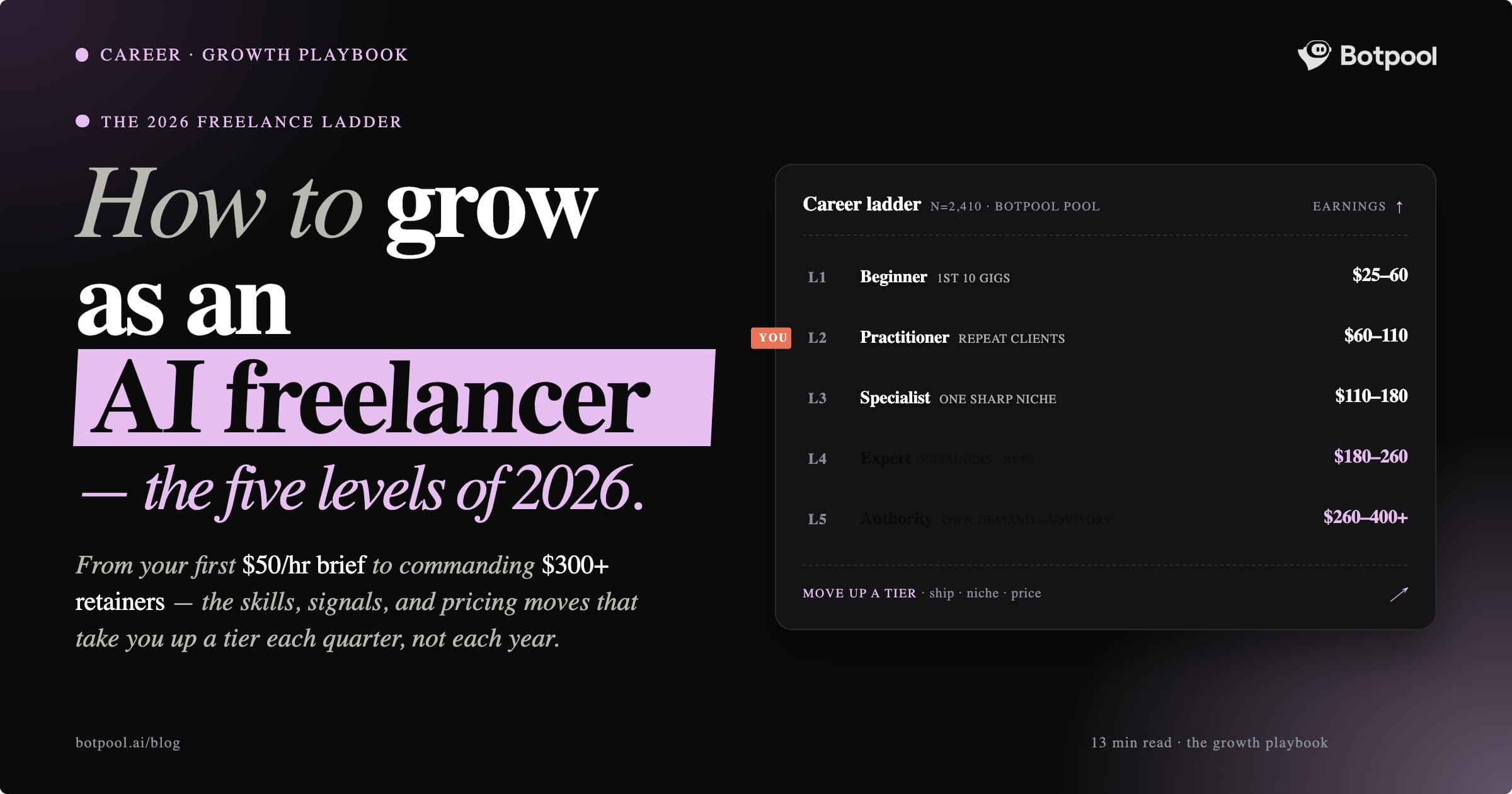

Growing as an AI freelancer in 2026 means more than knowing how to write a prompt. Clients want people who can connect AI tools to real outcomes, whether that is automating a workflow, producing content at scale, or building a custom chatbot. The freelancers winning right now are specialists, not generalists. They charge for results, not hours. And they pick a niche before they pick a platform.
What Does It Mean to Be an AI Freelancer in 2026?
An AI freelancer uses artificial intelligence tools to deliver professional services for clients. This includes tasks like AI content creation, prompt engineering, workflow automation, video generation, chatbot development, and data annotation.
The role sits at the intersection of technical skill and human judgment. You are not just running tools. You are managing quality, client expectations, and the gap between what AI generates and what actually works.
AI Freelancer vs Traditional Freelancer
Dimension | Traditional Freelancer | AI Freelancer |
Speed | Limited by hours worked | Delivers faster using AI tools |
Pricing | Hourly or project flat rate | Value-based, outcome-focused |
Skills | Single discipline | AI tools + domain expertise |
Scalability | Capped by personal capacity | Scales with automation |
Client demand | Broad | Growing fast, high specificity |
What Are the Most In-Demand AI Skills for Freelancers Right Now?
Across major freelance platforms in 2026, these AI skills are seeing the sharpest growth in client demand
AI Video Generation and Editing: Up 329% year over year. Tools like Runway and Sora 2 are used to create video content from text prompts, then edited into polished final assets.
AI Integration: Up 178%. Connecting AI tools to CRMs, dashboards, and ops systems using APIs and automation platforms.
AI Data Annotation and Labeling: Up 154%. Cleaning and tagging data for model training. Still a very human task despite AI growth.
AI Image Generation and Editing: Up 95%. Specialized design work using generative tools for brand content and marketing.
AI Chatbot Development: Up 71%. Building intelligent bots for customer support, lead capture, and internal use.
Automation Engineering: Using AI to replace repetitive tasks across business workflows. High demand in operations and marketing.
How Should You Position Yourself as an AI Freelancer?
Most new AI freelancers make one mistake. They try to offer everything. That approach gets you ignored.

The better strategy is to pick one industry and one AI capability and go deep. Here is a simple positioning framework:
Choose a niche: legal, e-commerce, SaaS, real estate, healthcare
Choose a capability: content automation, chatbot builds, video production, workflow integration
Combine them into a specific offer: 'I build AI-powered support chatbots for SaaS companies'
Build 2 to 3 case studies showing a specific result
Set your rate based on what the outcome is worth, not how long it takes
How Do You Price AI Freelance Services in 2026?
AI freelancers should avoid pricing only by the hour when the work creates clear business value. Hourly pricing can work for open-ended tasks. But for clear outcomes, packages and value-based pricing are often better.
Pricing model | Best for | Example |
Hourly | Ongoing support or unclear scope | AI assistant improvements |
Fixed package | Clear deliverables | Chatbot setup, prompt audit |
Milestone based | Multi-step builds | Automation workflow rollout |
Retainer | Continuous support | Monthly AI content ops |
Value based | High-impact work | Lead automation or revenue workflow |
Useme notes that freelancers who use AI should still rely on strategic thinking, clear communication, and human expertise, as tool speed alone is not enough.
What Platforms Should AI Freelancers Use in 2026?
Choosing the best AI freelance platform depends on your niche and where your clients already are. Here is a quick breakdown:
Platform | Best For | AI Features |
Botpool | AI-specific freelance work | Built for AI services, resell tools, recurring revenue |
Upwork | Mid-to-large business clients | AI job matching, proposal assistance |
PeoplePerHour | Project-based work, UK clients | AI-powered client matching |
Toptal | Senior technical AI roles | Vetted network, premium rates |
Fiverr | Productized, fixed-scope gigs | Volume-based, good for entry-level |
If you are focused specifically on AI services, Botpool is worth exploring early. It is built around AI freelance work and includes resell tools that let you add recurring revenue to your business.
How Do You Build a Portfolio as an AI Freelancer With No Clients Yet?
You do not need paid clients to build a portfolio. You need results.
Here is a practical approach to get started:
Pick a real business problem in your niche
Use AI tools to solve it: build the chatbot, produce the content, automate the workflow
Document the before and after with numbers where possible
Publish it as a case study on your profile or a personal site
Offer one or two free or discounted projects to get testimonials
Clients care about outcomes. 'I reduced a client's content production time by 60% using AI' is worth more than any credential.
How Do You Move From One-Off Gigs to Stable AI Freelance Income?
Gigs are unpredictable. Retainers are not. The goal is to convert one-time clients into recurring ones.

Here are the transitions that work:
After a content project, offer a monthly package for ongoing output
After a chatbot build, pitch a maintenance and optimization retainer
After an automation setup, offer monthly check-ins and expansions
Bundle reporting so clients see ROI clearly each month
What AI Tools Should Freelancers Be Using in 2026?
The tools that matter depend on your specialty. Here is a practical breakdown by category:
Category | Tools | Use Case |
Content generation | Claude 4, GPT-5 | Long-form writing, editing, research |
Video generation | Sora 2, Runway | AI video creation and editing |
Image generation | Midjourney, Adobe Firefly | Brand visuals, design assets |
Workflow automation | Zapier AI, Make, n8n | Connecting apps, eliminating manual work |
Chatbot development | Botpress, Voiceflow | Customer-facing and internal bots |
Project management | Notion AI, ClickUp AI | Planning, summarizing, task management |
How Do You Handle Difficult Clients and Scope Creep as an AI Freelancer?
Scope creep occurs when a client asks for more than what was agreed upon in the original contract. It is very common with AI projects because clients often do not know what they need until they see early results.
Prevent it before it starts:
Write a clear scope document before any work begins
List exactly what is included and what is not
Define revision limits upfront, for example, two rounds of edits
Price extra work clearly in your contract from day one
Communicate progress in writing so there is always a record
When a client pushes beyond scope, respond with: 'That is a great idea. I can add that in a separate project or as an add-on. Here is what that would cost.' This keeps the relationship intact and gets you paid fairly.
How Do You Stay Competitive as AI Tools Keep Changing?
The tools will keep changing. The freelancers who stay competitive are the ones who adapt faster than their clients.
A few habits that help:
Spend 30 minutes a week reviewing AI tool updates and releases
Follow platform blogs like Upwork Research and PeoplePerHour guides for trend data
Test new tools on personal projects before pitching them to clients
Join communities where AI freelancers share what is working, such as Reddit, Discord, and LinkedIn
Document your own results and processes as your competitive edge
Final Thoughts
Growing as an AI freelancer in 2026 is not about learning every new tool. It is about choosing a niche, solving real business problems, and proving that your work creates value.
Start with one service. Build proof. Price around outcomes. Use AI to improve your own workflow. Then use platforms like BotPool to showcase your skills to clients looking for AI-focused talent.
The freelancers who grow will not be the ones who sound the most technical. They will be the ones who make AI useful, practical, and measurable for clients.
Frequently Asked Questions
1. Can I become an AI freelancer with no technical background?
Yes. Many high-demand AI freelance skills, such as content creation, video editing, and prompt engineering, do not require coding. Start with tools that have visual interfaces and grow from there.
2. How much can an AI freelancer earn in 2026?
Entry-level AI freelancers earn around $25 to $50 per hour. Specialists with a strong portfolio and niche focus often earn $75 to $150 per hour or more on value-based projects.
3. What is the difference between prompt engineering and AI integration?
Prompt engineering focuses on writing effective instructions for AI models. AI integration connects AI tools to existing systems, such as CRMs and databases, via APIs and automation platforms.
4. How long does it take to land your first AI freelance client?
With a focused niche and a basic portfolio, most freelancers land their first client within 4 to 8 weeks. Offering a free or discounted first project can significantly speed this up.
5. Should I specialize or stay a generalist as an AI freelancer?
Specialize. Generalists compete on price and are quickly filtered out. Specialists are easier to refer, harder to replace, and charge more because their value is specific and measurable.
6. Is Botpool a good platform for AI freelancers?
Botpool is built specifically for AI services, making it a strong fit if your work is AI-focused. It includes features such as resale tools and recurring revenue options that general platforms do not offer.
7. What is value-based pricing for AI freelancers?
Value-based pricing means charging based on the outcome your work creates for the client, not the hours you spend. If your automation saves a client $5,000 a month, a $1,500 setup fee reflects the value delivered.
8. How do I avoid burnout as an AI freelancer?
Set clear working hours, limit active clients to a manageable number, and use AI tools on your own admin tasks. Scope projects tightly and build retainers so you have predictable income without constant proposal writing.
