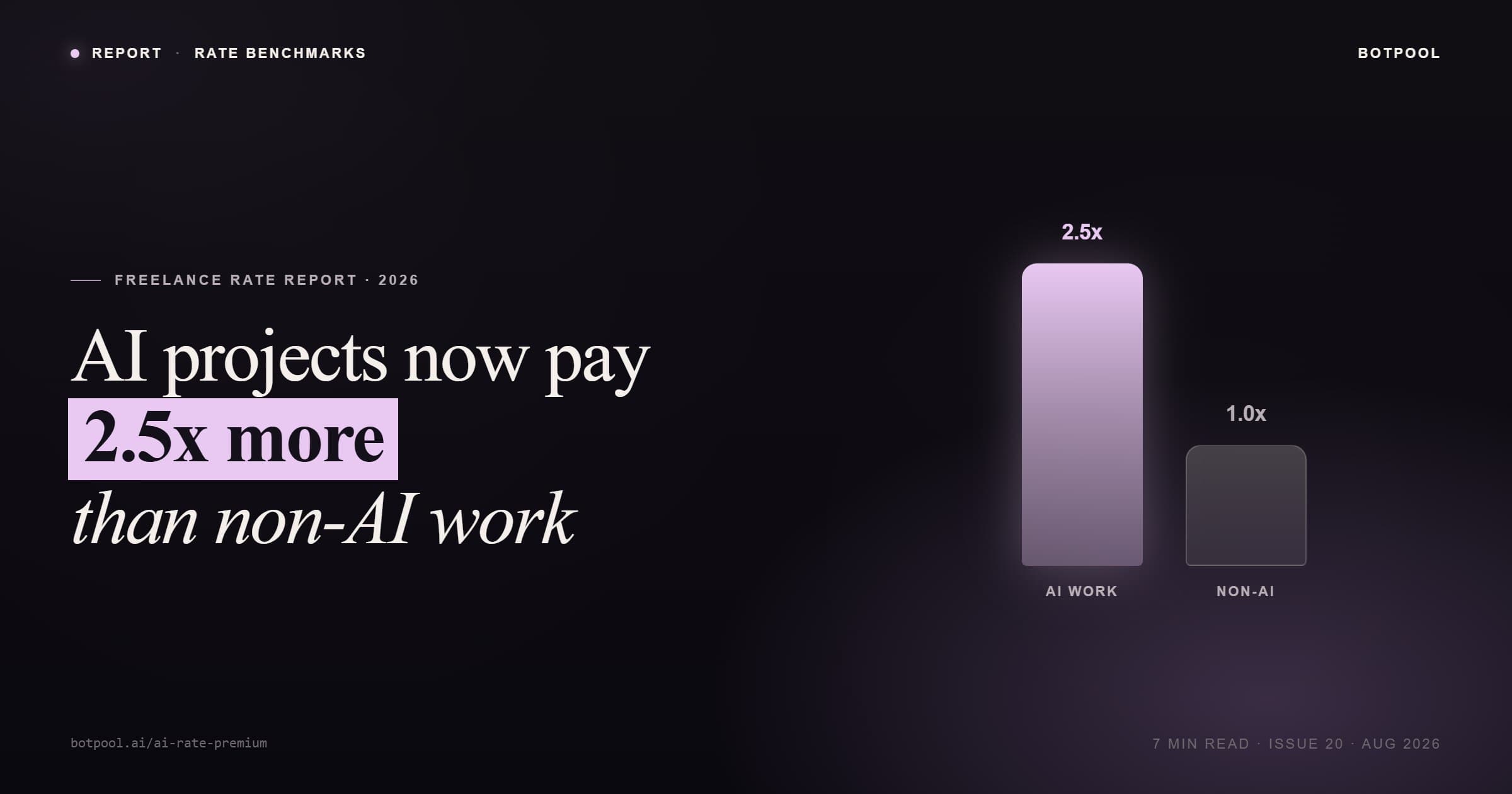

New data shows that AI freelance projects now pay about 2.5 times more than non-AI ones, and the gap is widening. The reason is a shift underneath the numbers. Basic AI tasks are becoming commodity work, while businesses pay a real premium for specialized, strategic AI talent. For any company hiring AI help, that changes what you should look for and what you should expect to pay.
Here is what the latest figures reveal, why the premium exists, and how to hire on the right side of it.
What the new data shows
According to fresh data from freelance platform Freelancer.com, reported by Forbes, the AI freelance market is booming and paying well:
- Around $8.27 million was spent on roughly 76,925 AI-tagged projects in the past year.
- AI projects paid about 2.5 times more on average than non-AI projects.
- The fastest-growing categories quarter over quarter are AI consulting (up 24%), AI content creation (up 21%), and AI agents (up 19%).
- Older categories are cooling. Automation projects fell 33%, and machine learning projects fell 28%.
This is not a single-platform blip. PwC's 2026 Global AI Jobs Barometer, built from more than a billion job ads across 27 countries, found that roles requiring AI skills now command a 62% wage premium over comparable roles without them, up from 57% a year earlier. Jobs that need specific AI skills are also growing roughly eight times faster than the overall job market.
Two independent datasets pointing the same way is a strong signal. AI skills are getting more valuable, not less.
Why AI projects now command a premium
The interesting part is where the money is moving. It is not flowing to the tasks you might expect.
Basic AI work is commoditizing. Almost anyone can write a prompt or spin up a simple chatbot now, so that work is getting cheaper and more crowded. The premium has shifted to the harder problems: integrating AI into real workflows, building agentic systems that chain many steps together, and governing how AI is used across a business.
In short, clients are no longer paying for "knows how to use AI." They are paying for judgment, domain expertise, and the ability to build systems that actually work in production. That is skilled, specialized work, and it prices accordingly.
The AI skills clients are paying more for
The data points to a clear set of rising, high-value specialties:
- AI consulting: helping businesses decide where and how to apply AI, and how to govern it
- Agentic AI: building AI agents and multi-step systems, not just single prompts
- AI content creation: producing content at scale with a real strategy behind it
- Custom integration: wiring AI into existing tools, data, and processes
Meanwhile, generic automation and standalone machine learning work is slowing. If you are mapping your own needs against the market, it helps to know which in-demand AI skills carry the most value right now.
What this means for businesses hiring AI talent
If AI talent costs more, the worst response is to shop on price alone. The data says the opposite is smart: the premium exists because specialized talent delivers outcomes that cheap, generic help cannot.
A few practical takeaways for hiring:
- Prioritize proven specialists over the lowest bid. The gap between a working AI system and a stalled one is expertise, so learning to vet AI freelancers is now a core hiring skill.
- Budget for the premium. These rates are the market, not a markup, so it pays to understand the real cost to hire an AI freelancer before you scope a project.
- Match the model to the project. For contained work, a vetted specialist is ideal. For complex, strategic builds you would rather not manage, managed AI delivery hands the whole outcome to a team.
The through line is simple. In a market paying a premium for specialization, hiring pre-screened AI specialists protects you from paying premium prices for generic work.
What this means for AI freelancers
The same data is a roadmap for freelancers. Generic AI services are the race to the bottom. The money is in specialization.
The strongest position is to combine AI skills with real domain expertise, then sell industry-specific solutions rather than generic tasks. A consultant who understands healthcare or finance, and can build AI for that context, charges far more than someone offering "AI automation" to everyone. Leaning into a niche is how you land on the high-value side of this premium.
Frequently asked questions
Do AI freelance projects really pay more?
Yes. Recent platform data shows AI projects paying about 2.5 times more than non-AI ones, and PwC reports a 62% wage premium for AI skills.
Which AI skills pay the most in 2026?
Consulting, agentic AI, and AI content creation are the fastest-growing, highest-value categories, while basic automation and standalone ML are cooling.
Why is basic AI work paying less?
Simple prompting and chatbot building have become commodity skills that almost anyone can do, so the premium has moved to strategic, specialized work.
Should businesses hire specialists or generalists for AI?
Specialists. The market premium reflects that vetted, domain-specific talent delivers outcomes generic help usually cannot.
Conclusion
The message from both datasets is the same. AI work is not getting cheaper; it is getting more specialized, and businesses are paying more for talent that can deliver real results. The winners on the hiring side are the ones who treat AI talent as a specialized investment, not a commodity to bargain down.
If you want to hire on the right side of that premium, Botpool connects you with pre-vetted AI specialists or delivers your project end to end through a managed team, so you pay for outcomes rather than guesswork.
