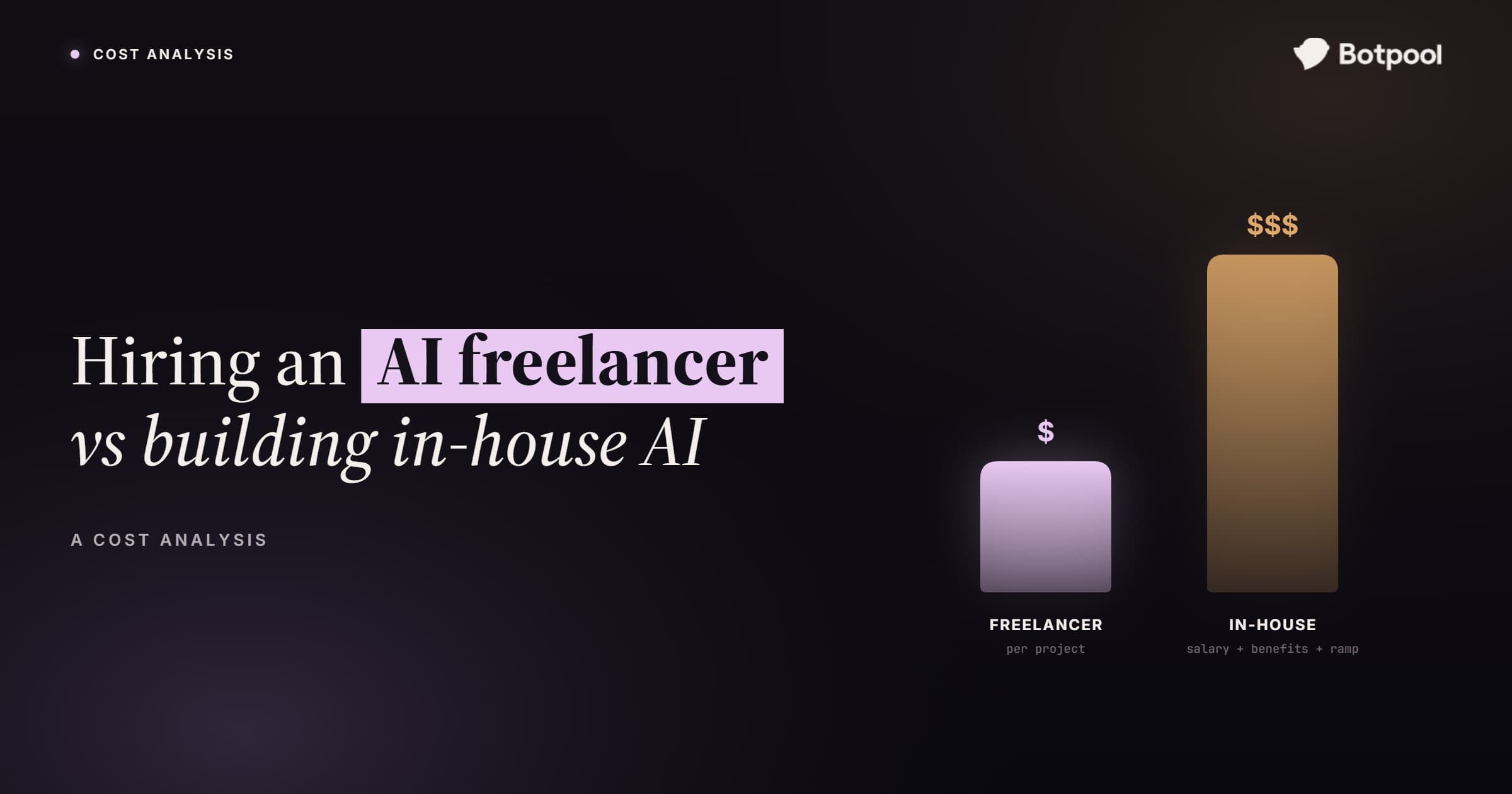

Hiring an AI freelancer is the faster, cheaper choice for defined, short-term projects, usually costing $50 to $250 per hour with no long-term commitment. Building an in-house AI team gives you control, security, and ownership, but a single senior AI engineer costs roughly $190,000 to $230,000 per year, including everything, and a small team runs well past $400,000. The right answer depends on whether AI is a one-off project for you or the core of your product.
Most businesses overspend by picking the wrong model, not by paying too much for the right one. This breakdown walks through the real numbers on both sides so you can budget with confidence.
The short answer
Choose a freelancer when the work is clearly scoped, short-term, or a test, and you want to pay only for what you use.
Build in-house when AI is central to your product, needs constant iteration, and touches sensitive data you must keep in-house.
Most businesses are better off starting with a freelancer to prove the idea, then hiring in-house only once AI becomes core.
What an AI freelancer actually costs

Freelancers bill by the hour or by project, and that is the whole appeal. You pay for the work and nothing else. There is no salary, no benefits, no equipment, and no cost when the project ends.
Typical US rates in 2026 look like this:
Hourly: around $50 to $150 for general AI work, and $100 to $250 for senior or specialized skills like model fine-tuning
Per project: a fixed fee for a defined build, such as a chatbot or an automation, which keeps your costs predictable
No overhead: no payroll taxes, health insurance, software licenses, or downtime between tasks
The hidden cost with freelancers is your own time. You scope the work, review it, and manage delivery yourself, and if the person disappears after handoff, there is often no support. Understanding the full cost to hire an AI freelancer means counting that management time, not just the rate you agree on.
What an in-house AI team actually costs

An in-house hire looks simple until you add up everything attached to a salary. The base pay is only the start.
For a single mid-level AI or machine learning engineer in the US, multiple 2026 salary sources put base pay around $135,000 to $190,000. Once you add benefits, tools, compute, and overhead, the fully loaded cost of employing one engineer ranges from roughly $190,000 to $230,000 per year, according to industry salary reports. Senior specialists run far higher.
The real cost of building in-house includes more than pay:
Fully loaded salary: benefits, payroll taxes, and equipment add 25% to 40% on top of base
Recruiting: hiring a mid- to senior AI engineer takes about 60 to 90 days, with a cost-per-hire of $22,000 to $45,000
Tools and compute: cloud, GPUs, and software licenses are ongoing
A team, not one person: most real AI work needs at least two or three people, which pushes the annual cost past $400,000
Key-person risk: if one engineer leaves, the knowledge and the roadmap can leave with them
In-house makes financial sense when that team is busy on core AI work year-round. It becomes an expensive mistake when a company hires a full-time engineer to do what a freelancer could deliver in a few weeks.
Freelancer vs in-house: the cost at a glance
Factor | AI freelancer | In-house AI team |
Cost model | $50 to $250 per hour, or per project | $190,000 to $230,000+ per engineer, per year |
Time to start | Days | 60 to 90 days to hire, plus ramp-up |
Commitment | None, ends with the project | Long-term salary and overhead |
Best for | Defined, short-term, or test projects | Core, ongoing AI that is your product |
Data and IP control | Good, with clear contracts | Highest, fully in-house |
Continuity | Ends at delivery | Ongoing, but tied to retention |
Management load | You manage the work | Built into the team |
Beyond cost: control, speed, and risk
Money is the headline, but three other factors decide the fit.
Speed. A freelancer can start in days. An in-house hire takes months to find, onboard, and ramp. If you need results this quarter, freelancing wins on time alone.
Control and security. In-house gives you full oversight of proprietary data, compliance, and intellectual property. For AI that handles sensitive customer data or is your core IP, that control is worth the cost.
Continuity. A freelancer is a single point of failure, and support often ends at delivery. An in-house team offers continuity, as long as you can retain them.
The pattern is simple. Freelancers trade continuity for speed and low cost. In-house trades cost and speed for control and permanence.
When each model makes sense
Hire a freelancer when:
The project is clearly defined and short-term, like one automation or a prototype
You are testing an AI idea before committing real budget
You need to start fast and keep costs variable
AI supports your business but is not the product itself
Build in-house when:
AI is a core differentiator and you will ship AI features for years
You need constant iteration and deep integration with your own product
Proprietary data and compliance require everything to stay in-house
You have enough ongoing AI work to keep a full team busy
The middle path most businesses miss
The freelancer-or-in-house choice is not either-or, and treating it that way is where budgets get wasted. Two flexible options sit in between.
The first is a vetted marketplace. Hiring pre-screened AI specialists removes the biggest freelancer risk, the screening and quality gamble, so you get freelancer economics with far less uncertainty. It also makes it easier to compare the best AI freelance platforms on how well they vet talent before you commit.
The second is managed delivery. If a project is too big for one freelancer but not worth a permanent team, managed AI delivery gives you a scoped plan, a fixed timeline, and a team that owns the outcome, without a $400,000 salary commitment. For most businesses proving out AI, one of these two paths beats both extremes.
Conclusion
On pure cost, a freelancer wins for defined, short-term work, and in-house only pays off when AI is central to your business and running year-round. The expensive mistakes are hiring a full-time team for a one-off need, or stretching a lone freelancer across a system your operations depend on.
Match the model to the project, and start lean when you can. If you want freelancer flexibility without the screening risk, Botpool connects you with vetted AI specialists or delivers the full build through a managed team, so you only pay for the outcome you need.
