
Marketing teams used to spend most of their week on execution. Writing the copy. Cutting the video. Setting the bids. Checking the numbers. Then doing it all again next week.
In 2026, a lot of that work runs itself.
AI has moved past being a writing assistant that helps you draft an email faster. It now touches almost every stage of a marketing operation, and the teams pulling ahead are the ones who know which parts to hand off and which parts still need a human call.
This guide breaks down where AI actually fits into content, advertising, and campaign management right now, and where it still falls short.
Where AI Fits Into a Modern Marketing Stack
Marketing has always been a mix of creative work and repetitive operational work. AI has mostly taken over the second kind, and it is getting better at the first.
Marketing is just one piece of a much wider shift. The same logic behind using AI in your business across support, finance, and operations applies here too, just with different tools and different outputs.
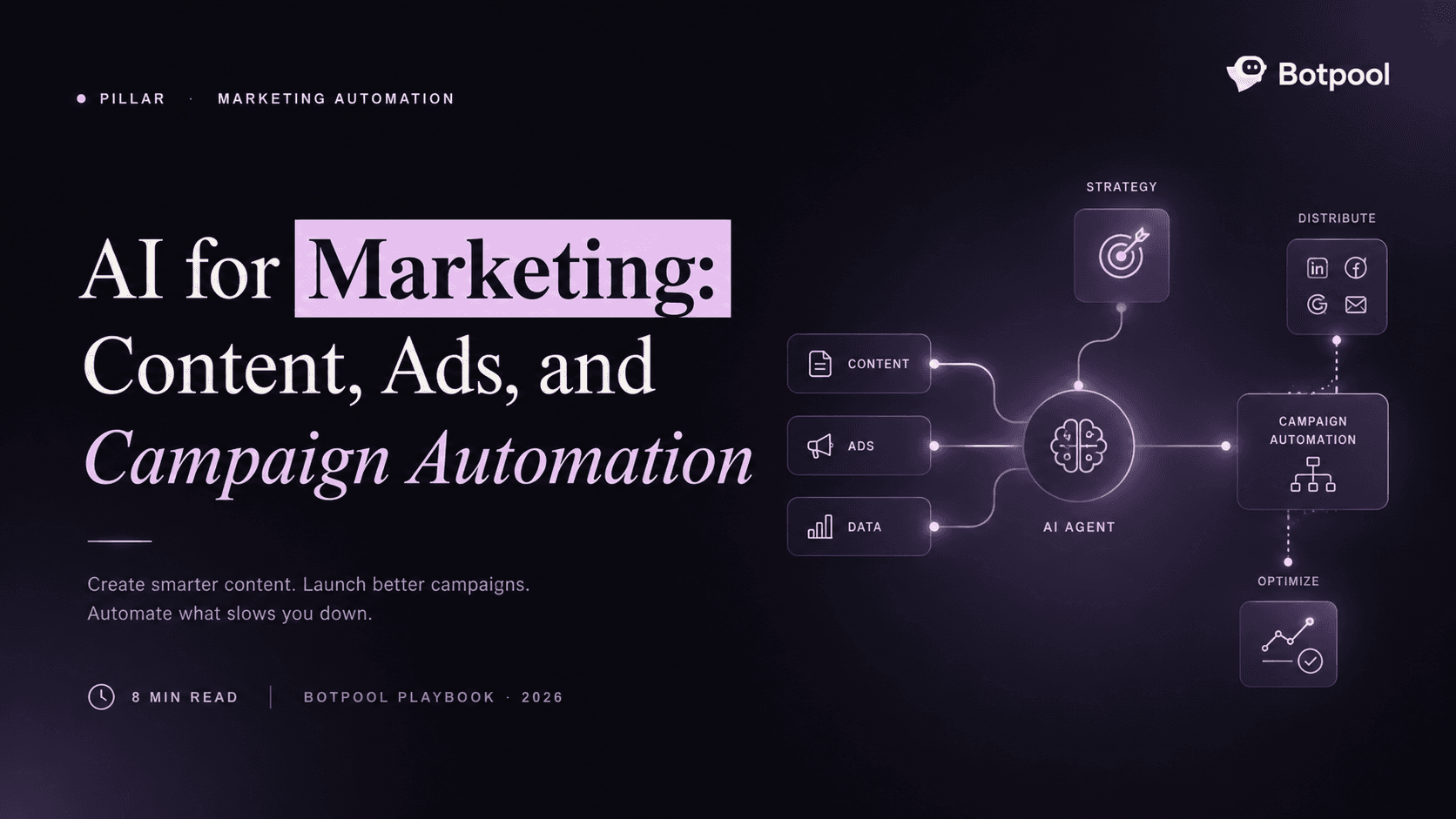
For marketing specifically, three areas have changed the most: content production, advertising, and campaign orchestration.
AI Content Creation: Fixing the Execution Bottleneck
Content used to be the slowest part of marketing. Now it is often the fastest.
Writing. Tools built on large language models handle first drafts of hooks, ad scripts, and emails in minutes. Marketers still edit and shape the final version, but the blank page problem is mostly solved.
Design and video. Platforms like Canva build out brand kits and graphics automatically. Tools like CapCut auto-caption and trim raw footage into short clips, cutting hours of manual editing down to minutes.
Content strategy. A separate category of tools maps out what to write about in the first place, spotting gaps in a site's existing content and building briefs around topics with real search demand.
No single tool does everything well. Pairing a specialized video tool with a general design tool tends to save more time than forcing one platform to do it all.
The catch is that AI-generated content still needs a point of view. A tool can write ten variations of a headline, but it cannot tell you which one matches how your actual customers talk. That judgment call still sits with a person.
AI Advertising and Ad Automation
Paid ads have quietly become one of the most automated corners of marketing, though not all of it is automated to the same degree.
Simple rule-based triggers, like pausing an ad set that overspends, have existed for years. Most platforms today go further than that. Google Performance Max and Meta Advantage+ handle targeting and bid adjustments in real time, reacting to signals across thousands of auctions a day. Newer tools go a step earlier, predicting which audience segments will convert before a campaign even launches.
Fully autonomous advertising, where a system plans and runs a campaign with almost no manual input, is still rare in practice, no matter what a platform's marketing page claims.
That gap between the pitch and the actual capability is worth watching for. If a platform cannot explain why it made a bidding decision, or it quietly optimizes toward its own ad inventory instead of your results, that is worth questioning before you hand it your budget.
Automated bidding can also chase the wrong goal if it is not set up correctly, and it has no instinct for brand safety or creative fatigue. The best results come from treating these platforms as a co-pilot, not an autopilot, while a person still owns the strategy.
That same instinct for avoiding wasted spend is why businesses are also using AI to reduce operating costs well beyond just the marketing budget.
Campaign Automation and Orchestration
The biggest shift in 2026 is not any single tool. It is how those tools now talk to each other.
Marketing automation used to mean setting up an if-this-then-that email sequence and hoping it still made sense six months later. Now platforms connect email, SMS, and web behavior into one shared view of the customer, adjusting campaigns in real time based on what a person actually does.
This lets a brand personalize the customer journey using first-party data, without a marketer manually updating segments every week. The system refines itself as new data comes in.
Different tools still specialize in different pieces of this, though. Some focus on CRM-driven email and lead nurturing, others on account-based targeting for B2B, others purely on analytics to show which channel actually drove the result. The mistake is trying to run all of it through one bloated platform instead of picking tools that connect well and cover the workflow you actually have.
What Still Needs a Human
AI can write, design, target, and adjust budgets. What it cannot do is understand your brand's reputation risk, or make the call when a campaign is technically performing but starting to feel off-brand. Those are still human decisions, and they carry real consequences if they get missed.
That is also why most businesses are not trying to build a full in-house AI marketing team from scratch. It usually makes more sense to bring in a specialist on a project basis, and hiring an AI freelancer for that setup work typically costs less than a full-time hire. Once the systems are running, the automation carries most of the day to day on its own.
Getting Started Without Overhauling Everything at Once
You do not need to automate your entire marketing function in one move.
- Pick one repetitive task, like ad copy variations or campaign reporting, and automate that first.
- Let the platform-level bidding tools run for a few weeks before layering on predictive targeting.
- Keep a human reviewing brand voice and creative decisions, even as production speeds up.
- Revisit your stack every quarter. What was cutting edge six months ago is often standard now.
Frequently Asked Questions
What are the best AI tools for digital marketing in 2026?
It depends on the job. Content generation, SEO planning, ad automation, and campaign orchestration are handled by different types of tools, and most teams end up running two or three together rather than one all-in-one platform.
What are the key AI trends in advertising for 2026?
Real-time bid optimization and predictive audience targeting are now standard on the major ad platforms. The bigger trend is orchestration, where planning, buying, and reporting connect into one workflow instead of living in separate tools.
Which AI is best for generating marketing content?
Large language model tools handle first-draft copy well, but the strongest results come from pairing that with a dedicated design or video tool. No single tool covers writing, visuals, and video equally well yet.
Which AI to use in 2026?
The right tool depends on what is actually slowing your team down. Name the one task eating the most hours, whether that is drafting, design, ad management, or reporting, then pick a tool built for that specific job.
Which free AI is best for marketing?
Most free tiers only cover basic drafting or scheduling, not the automation or targeting features that drive real results. They are a reasonable way to test a workflow before committing budget to a paid platform.
What AI is better than ChatGPT?
There is no single tool that beats ChatGPT across every marketing task. Specialized platforms tend to outperform it for SEO content planning, ad bid optimization, or campaign orchestration specifically, since those tasks need data ChatGPT alone does not have access to.
The Bottom Line
Marketing in 2026 still has a strategy problem at its center, not just an execution problem. AI has made execution fast and cheap, but it has not removed the need for someone who knows your brand well enough to catch it when the machine gets something wrong.
Most businesses do not need a full-time AI marketing lead to get that. A freelancer who has already built these systems for other companies can get yours running in weeks instead of months, and that is exactly the kind of project Botpool connects businesses with vetted AI talent for.
