The State of AI Freelancing in 2026: Trends, Data, and What's Coming Next
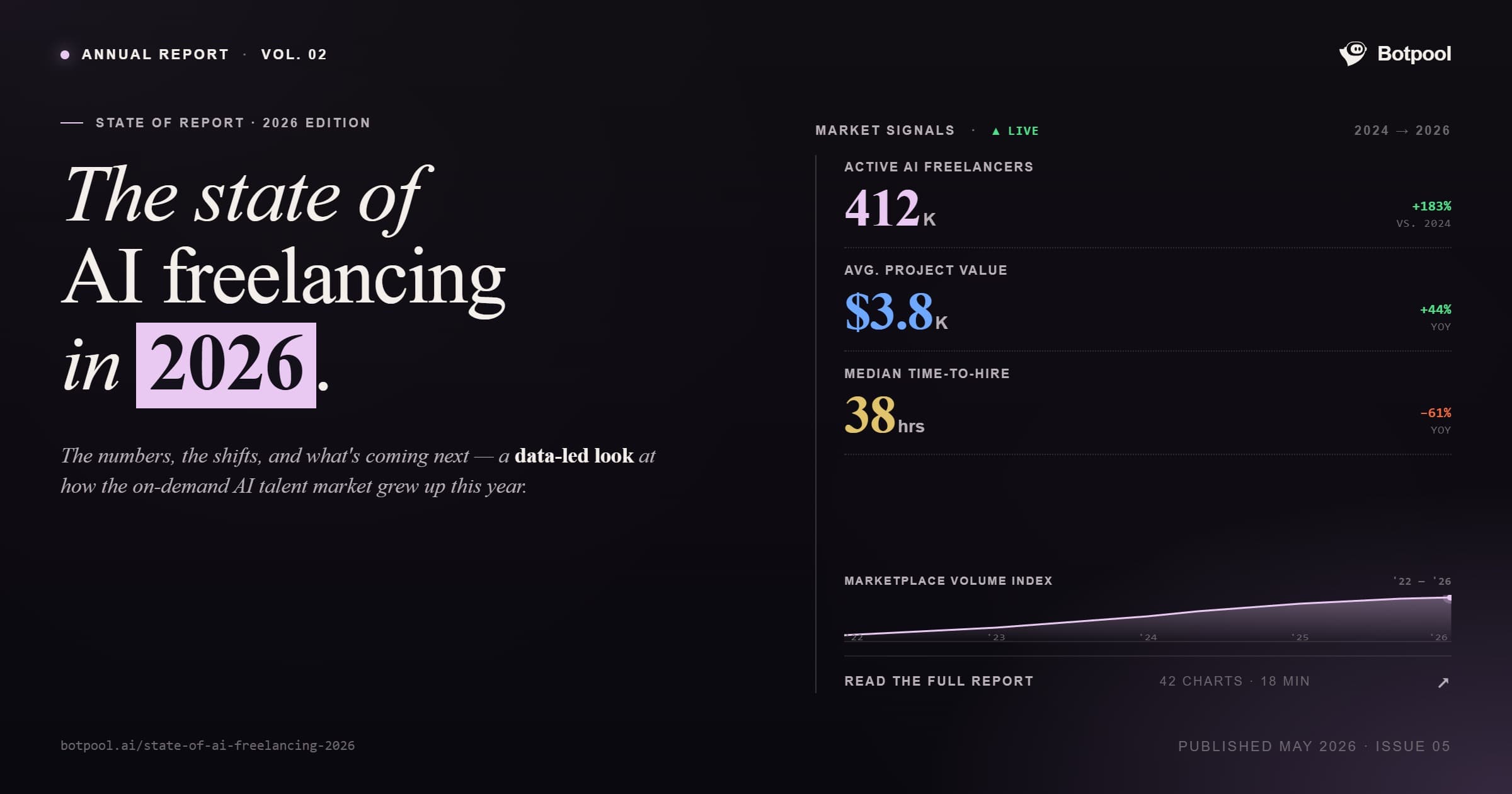

AI freelancing in 2026 is no longer a side category. It is one of the fastest-growing segments of the global talent market. The World Economic Forum's Future of Jobs Report 2025 ranks AI and machine learning specialists among the top three fastest-growing jobs globally through 2030.
Gartner forecasts that worldwide AI spending will reach $2.52 trillion in 2026, a 44% year-over-year increase. This guide breaks down the verified trends, data, and shifts shaping AI freelancing right now, as well as what's coming next.
What Is AI Freelancing in 2026?
AI freelancing is independent, project-based work where specialists build, integrate, or operate AI systems for businesses. It includes prompt engineering, AI integration, chatbot development, automation, voice agents, AI video editing, and data annotation.
In 2026, this segment is the engine of overall freelance growth, not a niche inside it.
How Big Is the AI Freelance Market in 2026?
The numbers from primary research show clear acceleration.
The World Economic Forum reports that 86% of employers expect AI and information processing to transform their business by 2030, and AI specialists rank among the top three fastest-growing jobs globally through 2030.
Gartner's 2026 forecast adds two key data points: worldwide AI spending will hit $2.52 trillion this year, and 40% of enterprise applications will embed task-specific AI agents by year's end, up from less than 5% in 2025.
Deloitte's State of AI in the Enterprise 2026 found that 84% of organizations investing in AI report positive ROI.
The pattern is consistent across every major report. AI is moving from experimentation to production at scale.
What Are the Key AI Freelancing Trends in 2026?
Six trends define the year.
1. AI-Related Freelance Skill Demand Has More Than Doubled
Industry data from the 2026 In-Demand Skills Report shows AI-referenced freelance skills grew 109% year over year, more than four times the growth of other in-demand skills. AI video generation and editing led growth at 329%, followed by AI integration at 178%.
This is the largest gap between AI and non-AI skill demand on record.
2. Outcome-Based Hiring Is Replacing Hourly Billing
Businesses increasingly pay for results, not time. Deloitte data shows organizations using outcome-based workforce models report 30% faster project completion and 20% lower delivery costs.
Gartner predicts that by 2030, at least 40% of enterprise SaaS spend will shift toward usage, agent, or outcome-based pricing.
3. Human-AI Collaboration Beats AI Alone
Productivity research published in 2026 found that human-AI collaboration boosts project completion by up to 70%, even on simple tasks.
This is the data point ending the "AI replaces freelancers" debate. AI augments expertise; it does not replace it.
4. The AI Skills Gap Is Widening
The World Economic Forum reports that 39% of workers' core skills will be transformed or become outdated between 2025 and 2030. Two-thirds of businesses plan to hire talent with specific AI skills by 2030, but the supply of qualified candidates is not keeping up with demand.
This is why specialized freelance hiring continues to accelerate.
5. Specialization Pays More Than Generalist Skills
A recent industry survey of 349 business leaders found that roughly half would pay a premium for independent talent who are creative and innovative.
Generalist freelance roles are commoditizing. Specialists are not.
6. AI Agents Are Becoming Production Infrastructure
Gartner forecasts that 40% of enterprise applications will embed task-specific AI agents by the end of 2026, up from less than 5% in 2025.
This shift is creating a new freelance category: AI agent builders, integrators, and operators.
Which AI Freelance Skills Are in Highest Demand?
Based on 2026 marketplace data, the fastest-growing AI skills by year-over-year demand are:
Skill | YoY Growth |
AI video generation and editing | +329% |
AI integration | +178% |
AI data annotation and labeling | +154% |
AI image generation and editing | +95% |
AI chatbot development | +71% |
All five categories had at least $100,000 in aggregate freelancer earnings during the measurement period.
How Are Businesses Hiring AI Freelancers in 2026?
More companies are choosing to hire vetted AI freelancers instead of waiting months to fill full-time roles. Three patterns stand out.
- Faster onboarding. Deloitte data shows freelance specialists are onboard 60% faster than full-time hires.
- Lower workforce costs. Gartner reports organizations using flexible talent models reduce workforce costs by up to 25%.
- Higher AI project ROI. McKinsey found that companies integrating external AI specialists into core teams are 1.7 times more likely to scale AI successfully. Industry-specific AI projects deliver up to 50% higher ROI compared to generic implementations.
What Does the State of AI Itself Tell Us About Freelancing?
The Stanford 2026 AI Index gives important context. AI adoption is now faster than the rollout of either the personal computer or the internet, and top AI models continue to improve despite predictions of a plateau.
Faster AI adoption directly fuels freelance demand because businesses cannot hire full-time AI staff fast enough.
What Is Coming Next for AI Freelancing?
Three forward-looking shifts are already underway.
Agentic AI Will Create New Freelance Roles
Gartner forecasts 40% of enterprise apps will include AI agents by end of 2026. This creates demand for agent designers, integrators, and operators. None of these roles existed at scale two years ago.
Specialized AI Marketplaces Will Outperform Generalists
Specialized AI-native platforms are reducing time-to-hire from 14 days to roughly 3.2 days, according to McKinsey's Future of Work research.
The shift toward specialized marketplaces reflects a broader pattern: businesses want vetted AI talent, not generalist freelancers learning AI on the job.
The "Human in the Loop" Becomes the Default
Productivity research shows human-AI collaboration outperforms AI working alone by up to 70%. The default project structure is shifting toward AI-augmented freelance work, not AI-only or human-only.
Pros and Cons of AI Freelancing in 2026
Pros
Highest demand growth of any freelance segment in 2026
Higher rates than generalist work
Faster project onboarding than full-time roles
Strong long-term outlook through 2030
Cons
Skills depreciate fast, with 39% expected to change by 2030
Generalist AI work is being commoditized
Quality bar for vetting is higher than traditional freelance
Pricing models are shifting from hourly to outcome-based, requiring new skills
FAQs
Is AI freelancing growing in 2026?
Yes. AI-related freelance skill demand grew 109% year over year, more than four times the growth rate for other high-demand skills.
Which AI freelance skill is growing fastest?
AI video generation and editing grew 329% year over year, making it the single fastest-growing AI skill in 2026.
Will AI replace freelancers?
No. Productivity research shows human-AI collaboration outperforms AI working alone by up to 70%. Demand for human expertise remains strong.
How much do AI freelancers earn compared to generalists?
Roughly half of business leaders say they would pay a premium for innovative independent talent. Specialized AI work commands higher rates than generalist freelance work.
What is the biggest shift in AI freelance pricing?
Outcome-based pricing is replacing hourly billing. Deloitte found that this model delivers 30% faster project completion and 20% lower delivery costs.
How fast can businesses hire AI freelancers?
Specialized AI marketplaces have reduced time-to-hire to roughly 3.2 days, down from 14 days on traditional platforms.
What AI roles will dominate by 2030?
AI and machine learning specialists rank among the top three fastest-growing jobs globally through 2030, according to the World Economic Forum.
What is the biggest risk for AI freelancers in 2026?
Skill obsolescence. The WEF reports 39% of workers' core skills will be transformed or outdated between 2025 and 2030, making continuous upskilling essential.
Conclusion
AI freelancing in 2026 is defined by three shifts: explosive demand growth, the move from hourly to outcome-based pricing, and the rise of human-AI collaboration as the default working model. Data from the World Economic Forum, Gartner, Deloitte, McKinsey, and Stanford HAI all point in the same direction. Businesses cannot hire AI talent fast enough internally, and specialized freelance platforms are becoming the default way to close that gap.
Botpool was built for this moment. Every freelancer on the platform is vetted for production AI experience across chatbots, voice agents, RAG, automation, and AI development.
If you are a business looking to ship AI features faster, post a project on Botpool and connect with vetted AI specialists in days, not weeks.
If you are an AI freelancer ready for higher-quality projects and lower platform fees, join Botpool and start getting matched with serious clients.
The next wave of AI freelancing is already here. The freelancers and businesses that win will be the ones working on platforms built specifically for them.
