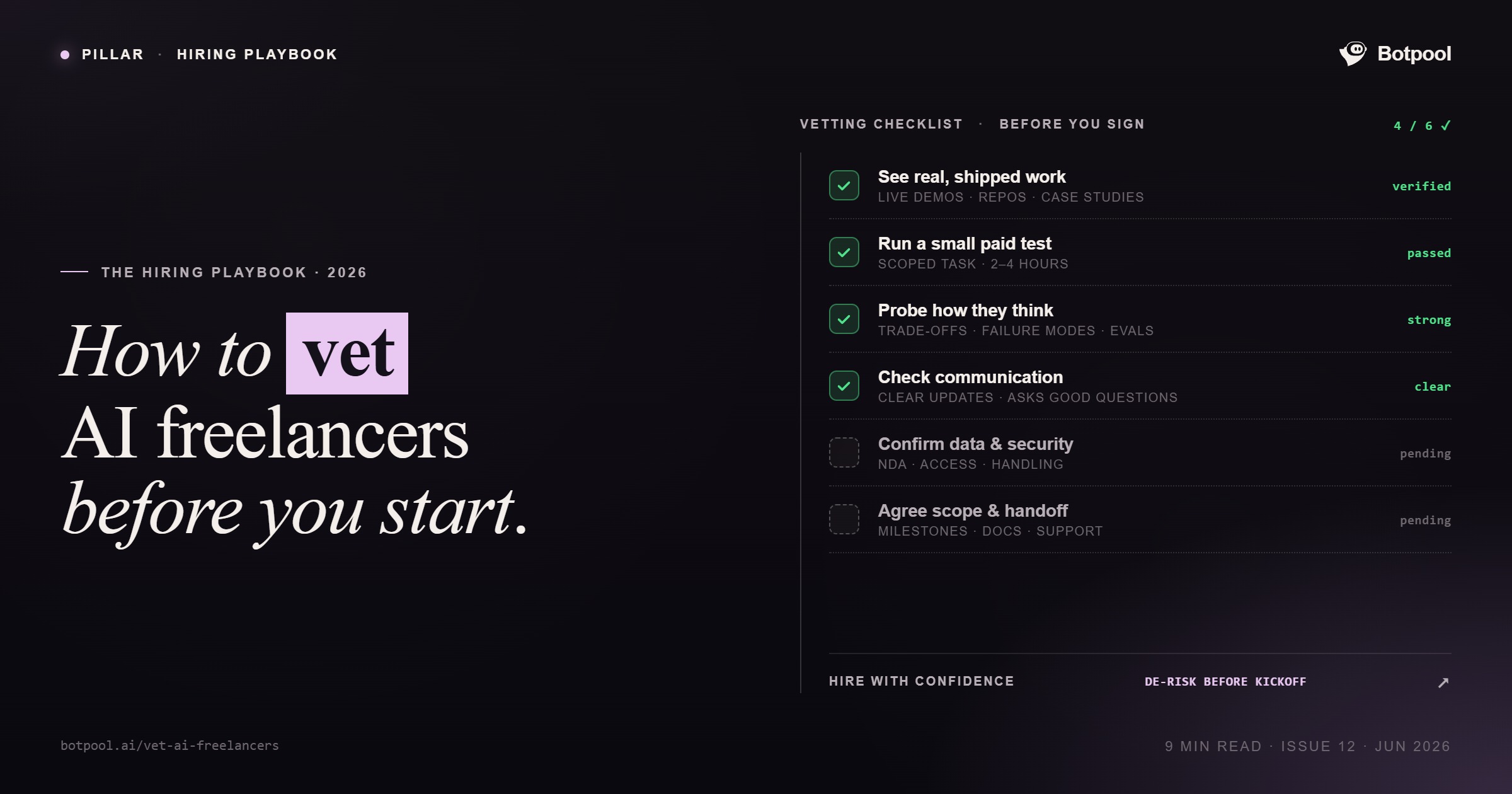
Vetting an AI freelancer comes down to one thing: proving they have shipped real production work, not just demos. Check their tech stack, ask for working prototypes, review their actual code or live builds, then run a small paid trial before committing.
Skip the vague portfolio reviews and resume claims. AI talent is easy to fake and hard to verify with surface checks, which is why a structured vetting process saves you weeks of rework and budget. This guide walks through exactly what to look for.
Why Is Vetting AI Freelancers Different from Regular Freelancers?
Regular freelancer vetting checks portfolio, reviews, and communication. AI vetting needs to go further because AI work is technical, evolving fast, and easy to fake.
Anyone can build a screenshot of an "AI chatbot." Few can ship one that handles real customer queries with low error rates. Vetting needs to surface that difference.
Three problems make AI vetting harder:
AI portfolios often show demos, not production work
Polished proposals are increasingly AI-written
Tools and frameworks shift every few months, so static skill claims age fast
The goal of vetting is to confirm they actually built what they claim, in the stack you need, with the depth your project requires.
What Should You Actually Check Before Hiring?

A solid vetting process covers six areas. Each one filters out a specific risk.
1. Real Production Work, Not Just Demos
Ask for a live link to something running in production, not a screenshot or video. Specifically:
A deployed chatbot URL you can interact with
A GitHub repository with real commits, not a single dump
A working voice agent number you can call
Screenshots of dashboards showing live usage data
If they cannot show real running work, the rest of the vetting does not matter.
2. Tech Stack Match
AI freelancers specialize. Someone who builds with Voiceflow may not be the right fit for a custom LangChain project. Confirm they have shipped with the exact stack your project needs.
Project Type | Stack to Confirm |
Chatbots | OpenAI, Claude, RAG, Pinecone, Voiceflow, Botpress |
Voice agents | Vapi, Retell, ElevenLabs, Twilio |
Automation | Zapier, Make, n8n, Airtable, custom APIs |
AI agents | LangChain, CrewAI, AutoGen, custom orchestration |
Custom AI | OpenAI API, Claude API, fine-tuning, vector databases |
Ask which specific tools they have shipped with, not which ones they have "worked with."
3. Engineering Standards
Even for no-code work, engineering discipline matters. Look for:
Clean code or workflow structure when you see their work
Documentation of how the system works
Error handling and edge cases considered
Versioning, backup plans, or testing approach
A freelancer who cannot explain how their system handles failures is not ready for production work.
4. Domain Knowledge
AI is a tool, but the result lives in your industry. If you are hiring for healthcare AI, financial chatbots, or legal automation, ask for domain experience.
Generalist AI freelancers can build technically sound systems that miss your industry's real needs. Specialization is worth a 20 to 40% premium on most production projects.
5. Security and Data Handling
AI projects often touch sensitive data. Ask three direct questions:
Where will the data be stored, and who has access?
Do they use APIs that train on customer data, or opt-out variants?
Are they familiar with GDPR, HIPAA, or SOC 2 if your business requires it?
Vague answers here are a red flag. Production-experienced freelancers have crisp answers to these.
6. Cost Awareness
AI projects can run away on API costs if the freelancer is not careful. Ask:
How will they track and cap token usage?
What monthly API or compute cost should you expect post-launch?
Do they include cost-monitoring in their setup?
Freelancers without a clear answer often deliver systems that cost 3 to 5x more to run than expected.
What Questions Should You Ask in the Vetting Call?

A 30-minute conversation reveals more than 10 portfolio reviews. Five questions filter most of the noise.
"Walk me through a project similar to mine, start to finish." Real builders narrate the decisions. Fakers describe the surface.
"What went wrong on a recent AI project, and how did you fix it?" Specifics here separate practitioners from theorists.
"How would you scope my project in the first week?" Tests whether they think in production terms or demo terms.
"What APIs or models would you recommend, and why?" Probes their understanding of tradeoffs (cost, latency, accuracy).
"How do you handle a model that gives wrong answers in production?" Reveals iteration depth and real-world experience.
If the answers are vague, generic, or feel templated, move on.
What Red Flags Should You Watch For?
Five patterns show up across bad AI hires. Catching any one is reason to pause.
No production examples, just demos and screenshots
Vague tech stack claims like "I work with all major AI tools."
Proposals that ignore your project specifics and use template language
Reluctance to do a small paid trial before a larger commitment
No clear answers on security, data handling, or API cost management
Polished proposals with these gaps are usually AI-written templates. Skip them.
How Do You Structure a Paid Trial Project?
A paid trial is the single best vetting step you can take. The goal is to see real work before committing to a larger budget.
Three rules make trials work:
Keep it small and defined. A trial should take 4 to 8 hours of work and have a clear deliverable. Building a simple FAQ chatbot, a single automation workflow, or a small data preprocessing script all work well.
Pay fairly. Free trials attract low-quality work. $100 to $300 buys you serious effort and tests how they handle paid work.
Evaluate beyond the output. Look at how they communicate, ask questions, and respond to feedback. Workflow fit matters as much as technical skill.
If the trial goes well, the full project usually does too. If it does not, you saved weeks.
How Long Should the Vetting Process Take?
For most projects, a focused vetting process takes 2 to 5 days. Here is a realistic breakdown.
Step | Time |
Review portfolio and request live demos | 30 to 60 minutes |
30-minute discovery call | 1 hour including prep |
Reference or past-client check | 30 to 45 minutes |
Small paid trial project | 1 to 3 days |
Skipping vetting saves a day. Hiring the wrong AI freelancer costs weeks. The math is obvious.
When Does the Marketplace Vet for You?
Vetted marketplaces shortcut most of this work. On Botpool, every AI freelancer passes a vetting process before listing services, which confirms their AI expertise upfront.
That means you can skip generic verification and focus on project-fit checks: tech stack match, domain knowledge, and the paid trial if needed. For a deeper look at what AI freelancers do and the roles available, see our guide on what an AI freelancer is and the skills they bring.
If you are still unsure which type of specialist your project needs, our breakdown of which AI freelancer you actually need walks through each role.
Pros and Cons of Each Vetting Method
Method | Pros | Cons |
Portfolio review | Fast, free, surfaces obvious mismatches | Easy to fake with demos |
Discovery call | Tests real understanding | Time-intensive at scale |
Reference check | Validates past work | Slow, references often biased |
Paid trial | Most reliable signal | Adds 1 to 3 days and small cost |
Marketplace vetting | Removes baseline checks | Still need project-fit confirmation |
Most teams combine 2 or 3 of these. Portfolio plus discovery call covers most small projects. Add a paid trial for anything above $5,000.
Common Mistakes That Lead to Bad AI Hires
Three mistakes show up over and over.
Skipping the paid trial on bigger projects. A 4-hour trial is the cheapest insurance you will ever buy on an AI hire.
Hiring on rate alone. The cheapest AI freelancer often delivers the most expensive total cost when rework, missed deadlines, and API overruns are counted.
Vague briefs. Bad briefs attract bad applicants. A clear brief filters out 50% of weak candidates before vetting starts. For exactly how to write one, see our guide on how to write an AI project brief that attracts qualified freelancers.
FAQs
What is the most important thing to check when vetting an AI freelancer?
Real production work. Ask for a live link or working prototype, not screenshots or demos. Everything else builds on this.
Should I always do a paid trial before hiring?
For projects above $2,000, yes. The trial costs $100 to $300 and saves weeks of risk on a larger commitment.
How do I check if a freelancer's AI portfolio is real?
Ask for live URLs, GitHub repositories, or working demos you can interact with. Ask them to walk through how they built it, what went wrong, and how they fixed it.
What questions reveal whether an AI freelancer is qualified?
Ask them to narrate a similar project end-to-end, explain what went wrong, and describe how they handle wrong AI outputs in production. Real builders have specific answers.
Do I need a technical background to vet an AI freelancer?
No. Focus on whether they can show real production work, explain decisions clearly, and communicate well. Technical depth matters less than demonstrated outcomes.
What is the biggest red flag in AI freelancers?
Polished proposals with no live production examples. AI-written cover letters are common now. Live builds are not.
How fast can I vet a freelancer for a small project?
A simple project under $1,500 can be vetted in 1 to 2 days through portfolio check and a 30-minute call. Add a paid trial for anything larger.
Does Botpool handle the vetting for me?
Yes. Every freelancer on Botpool passes a vetting process before listing services, so you can focus on project-fit checks like tech stack match and domain knowledge.
Conclusion
Vetting an AI freelancer is not about resumes or generic checklists. It is about confirming they have shipped real production work in the stack your project needs, can communicate clearly under pressure, and will not blow up your API budget or expose your data.
A focused 2 to 5-day process catches 95% of risks. A small paid trial catches almost all the rest.
If you want to skip the baseline verification entirely, post your project on Botpool and get matched with vetted AI freelancers who have already cleared the technical and skill checks. You can focus on what matters: project fit and outcome.
