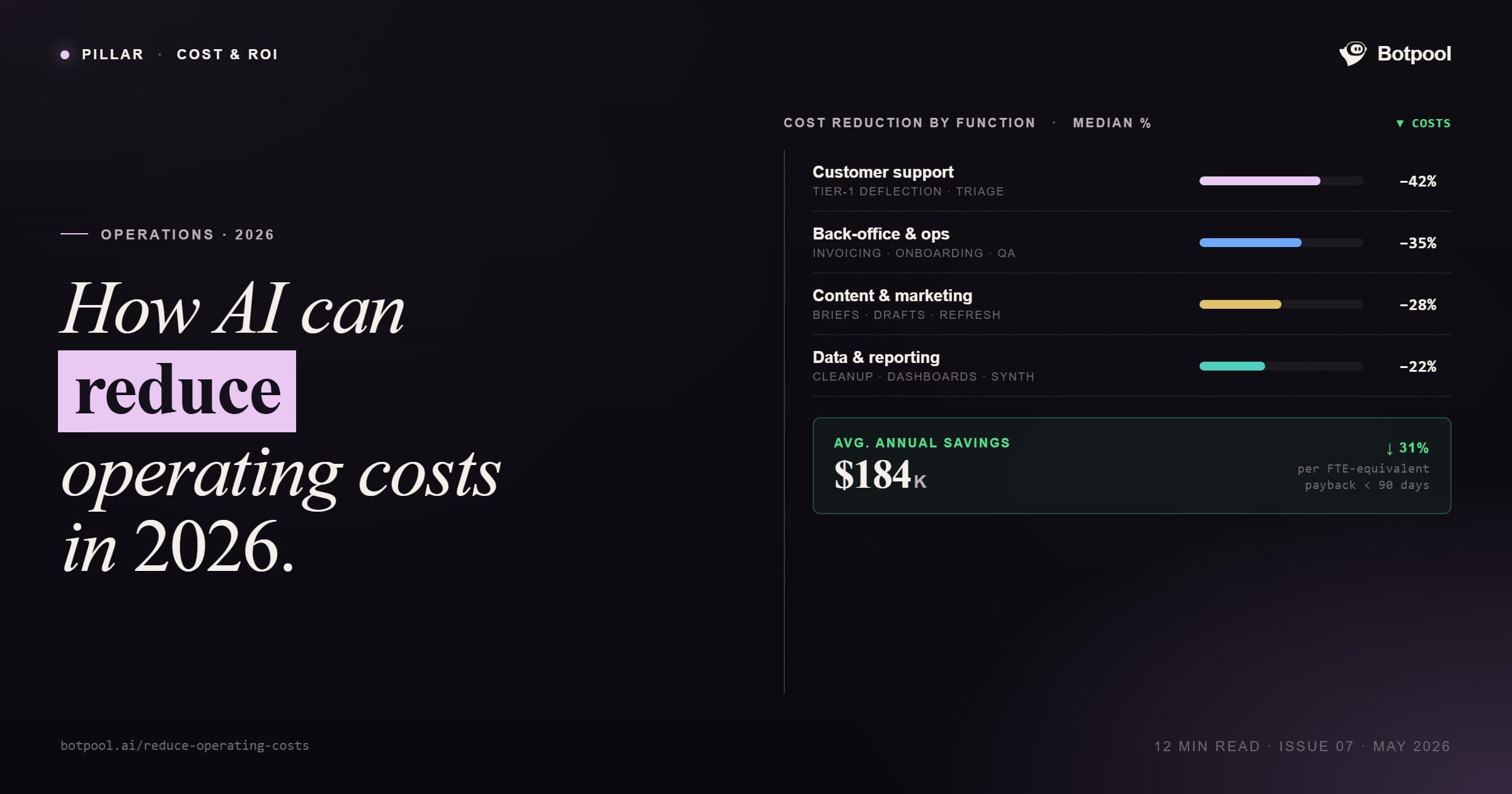

AI reduces operating costs by automating repetitive tasks, predicting equipment failures, optimizing supply chains, and cutting energy use. Most businesses using AI see 5% to 20% savings in the first year, with leading companies hitting 30% or more. The trick is not just buying AI tools but rethinking how the work gets done around them.
This guide walks through where AI saves the most money, how to actually capture those savings, and what to avoid so you don't waste budget on tools that look smart but don't pay back.
What Does It Mean to Use AI for Cost Reduction?
AI cost reduction means using machine learning and generative AI to do work faster, with fewer errors, and at a lower cost than manual processes. Unlike old automation that follows strict rules, AI handles messy data, unpredictable situations, and tasks that need judgment.
That makes it useful for cost areas that traditional tools could never touch.
How Much Can AI Reduce Operating Costs?
The savings vary by function and how deeply AI is integrated.
5% to 20% overall cost savings are typical across operations (TTMS, 2025)
15% to 45% cost reduction in procurement when AI streamlines manual work (BCG, 2025)
30% to 40% efficiency gains in document-heavy R&D processes (BCG biopharma case study, 2025)
20% to 30% reduction in marketing agency costs through GenAI content (BCG, 2025)
IBM unlocked roughly $3.5 billion in cost savings and a 50% increase in enterprise productivity over two years (BCG, 2025)
84% of organizations investing in AI report positive ROI (Deloitte, 2026)
The pattern is clear. Companies that redesign processes around AI save more than those that add AI to existing workflows.
Where Does AI Reduce Operating Costs the Most?
Eight areas drive most of the savings. Some are quick wins. Others are bigger plays that take more setup but pay back harder.
1. Automating Routine Tasks
AI handles email replies, data entry, customer FAQs, and report generation without human input. McKinsey found 57% of US work hours could already be automated with current technology.
This is usually the fastest area to show ROI.
2. Predictive Maintenance
For any business with physical assets, unplanned downtime is one of the most expensive line items. AI watches sensor data, spots patterns that lead to breakdowns, and warns you before equipment fails.
Predictive maintenance typically cuts equipment costs by 20% to 25% and can reduce breakdowns by up to 70%, according to Deloitte. Manufacturing, logistics, and facility-heavy businesses see the biggest returns.
3. Supply Chain and Inventory Optimization
AI forecasts demand more accurately than legacy systems. The result is less overstock, fewer stockouts, and lower warehousing costs.
Procurement specifically can see 15% to 45% cost reductions when AI is applied properly (BCG, 2025).
4. Energy Management
AI systems analyze building data to optimize HVAC, lighting, and equipment schedules. Companies using AI for energy management report 10% to 30% savings on utility bills.
For multi-location businesses, this scales fast.
5. Customer Support Automation
AI chatbots handle Tier-1 questions, password resets, and order tracking. Bank of America's Erica handles millions of customer queries and saves the bank an estimated $100 million annually in support costs.
Most businesses see 60% to 80% support deflection within 90 days of deployment.
6. Fraud Detection and Risk Reduction
AI scans transactions in real time to flag anomalies. This reduces financial losses from fraud and lowers compliance investigation costs.
Banks and insurance firms typically see the highest returns here.
7. Marketing and Ad Spend
AI optimizes targeting, bidding, and creative testing. Wasted ad spend drops, and ROAS improves.
One BCG case study showed marketing agency costs dropping 20% to 30% after GenAI content workflows replaced manual production.
8. HR and Recruitment
AI screens resumes, schedules interviews, and answers candidate questions. Recruitment teams using AI report reviewing 3x more candidates in the same time, with lower cost per hire.
How Do You Implement AI for Cost Savings?
The companies that see the biggest wins follow the same playbook. Four steps.
- Audit your cost base: Find the functions where labor or repetitive work eats the biggest budget share. These are your AI candidates.
- Pick one process to redesign: This is the part most companies get wrong. They drop AI on top of an existing broken workflow and wonder why the savings are small. The trick is rebuilding the process around AI from the start.
- Run a pilot with measurable targets: Set a clear cost or time-saving goal. Track results against a baseline.
- Scale what works: Use the pilot data to expand to similar processes across departments.
This is also why BCG's 10-20-70 principle matters: only 10% of AI value comes from the model itself, 20% from data and tech, and 70% from how you redesign the work around it.
What Are Real Examples of AI Cutting Operating Costs?
The biggest savings are easier to understand when you see what real companies actually shipped. Three documented examples cover different industries and different cost areas.
Klarna replaced the workload of 700+ customer service agents
The Swedish fintech rolled out an OpenAI-powered customer service assistant in early 2024. Within a month, it handled 2.3 million conversations, two-thirds of all customer chats, with resolution times dropping from 11 minutes to under 2.
Klarna initially estimated the assistant would drive $40 million in profit improvement that year. By Q3 2025, the company confirmed on its earnings call that the AI was doing the work of 853 full-time agents and had delivered $60 million in cost savings.
The honest part of the story: Klarna later reintroduced human agents for complex disputes and sensitive cases. The lesson is not AI versus humans. It is letting AI handle the high-volume, simple work so humans can focus on the cases that actually need them.
Sources: OpenAI press release, Klarna Q3 2025 earnings call.
JPMorgan Chase saved 360,000 legal hours a year with one tool
JPMorgan built an internal AI system called COiN (Contract Intelligence). It reads commercial loan agreements, pulls out around 150 key attributes, and flags issues without a human reviewer.
Before COiN, the bank spent roughly 360,000 hours every year manually reviewing about 12,000 commercial credit agreements. The AI does the same work in seconds. The bank also reported a sharp drop in loan-servicing errors, most of which had come from human misinterpretation of contract language.
JPMorgan has since expanded the system to other document types, including credit-default swaps and custody agreements.
Sources: JPMorgan disclosures, originally reported by Bloomberg and widely covered since.
Walmart cut 30 million delivery miles with AI route optimization
Walmart's machine learning route optimization removed around 30 million unnecessary driving miles from its delivery network. The technology worked so well that Walmart now sells it as a SaaS product to other businesses through its Route Optimization platform.
On the procurement side, Walmart deployed an AI agent to negotiate with smaller suppliers. The bot reached agreements with 68% of suppliers it engaged, averaging 1.5% in cost savings plus 35 extra days of payment terms. Across thousands of suppliers, that adds up to hundreds of millions in working capital impact.
Sources: Walmart Global Tech blog, PYMNTS interview with Parvez Musani (SVP, Walmart U.S. Omni Platforms).
The pattern across all three is the same. Find a high-volume process, redesign it around AI, and accept that the real win is augmentation rather than replacement.
Pros and Cons of Using AI for Cost Reduction

When Should You Hire a Specialist Instead of DIY?
Off-the-shelf tools work for simple use cases like email automation, content drafting, or basic chatbots. But for cost transformations involving custom workflows, large data sets, or business-critical systems, the time and risk of DIY usually outweigh the cost of hiring a specialist.
Common signs you need to hire an AI specialist:
You want a custom AI tool tied to your specific contracts, products, or systems
You're automating something where errors have real financial consequences
You need integration with internal databases, ERPs, or legacy software
You want to scale a successful pilot across multiple departments
A vetted freelancer typically delivers in days what an internal team would spend weeks figuring out.
Common Mistakes That Reduce AI Cost Savings
- Automating broken processes. If the manual workflow is bad, the AI version will be too. Fix the process first.
- Skipping the value measurement: Without baseline metrics, you can't prove the ROI, and the budget gets cut at the next review.
- Underinvesting in change management: BCG's 10-20-70 principle exists for a reason. The model is only 10% of the value. The other 90% is process redesign and people adoption.
- Trying to scale too fast: Companies that try to deploy AI across 10 functions at once usually deliver poorly across all of them. Win one, then expand.
FAQs
How does AI reduce costs in business?
AI reduces costs by automating routine tasks, optimizing supply chains, predicting equipment failures, cutting energy waste, and improving fraud detection.
How much money does AI save businesses?
Most businesses see 5% to 20% operating cost savings in the first year, with mature implementations reaching 30% or more (BCG, 2025).
Is AI cost-effective for small businesses?
Yes. Tools like Zapier, ChatGPT, and Claude let small businesses automate at low cost. Most see ROI within 60 to 90 days.
What is the 10-20-70 rule for AI?
BCG's principle: 10% of AI value comes from the algorithm, 20% from data and tech, and 70% from process and people redesign.
Where does AI save the most money?
Customer support, document processing, procurement, and marketing typically deliver the fastest cost wins.
How fast can AI start reducing costs?
Simple automations show savings within weeks. Larger transformations show measurable ROI within 6 to 12 months.
Does AI reduce labor costs?
Yes, but mostly by reducing time spent on repetitive work, not by replacing roles. Employees redirect that time to higher-value tasks.
What is the biggest mistake in using AI for cost reduction?
Adding AI to existing broken workflows instead of redesigning the workflow around AI. This is the single biggest reason companies fail to capture promised savings.
Conclusion
AI cuts operating costs in two stages. The quick wins come from automating repetitive tasks like data entry, support tickets, and reporting. The bigger gains come from redesigning processes around AI, the way IBM, the BCG biopharma case, and the German energy provider did.
Start small with one process, measure the savings, then scale what works.
If you need help building production-grade AI tools that deliver real cost savings, hire vetted AI specialists on Botpool and connect with experts who ship in days, not months.
