Published on
30 April 2026
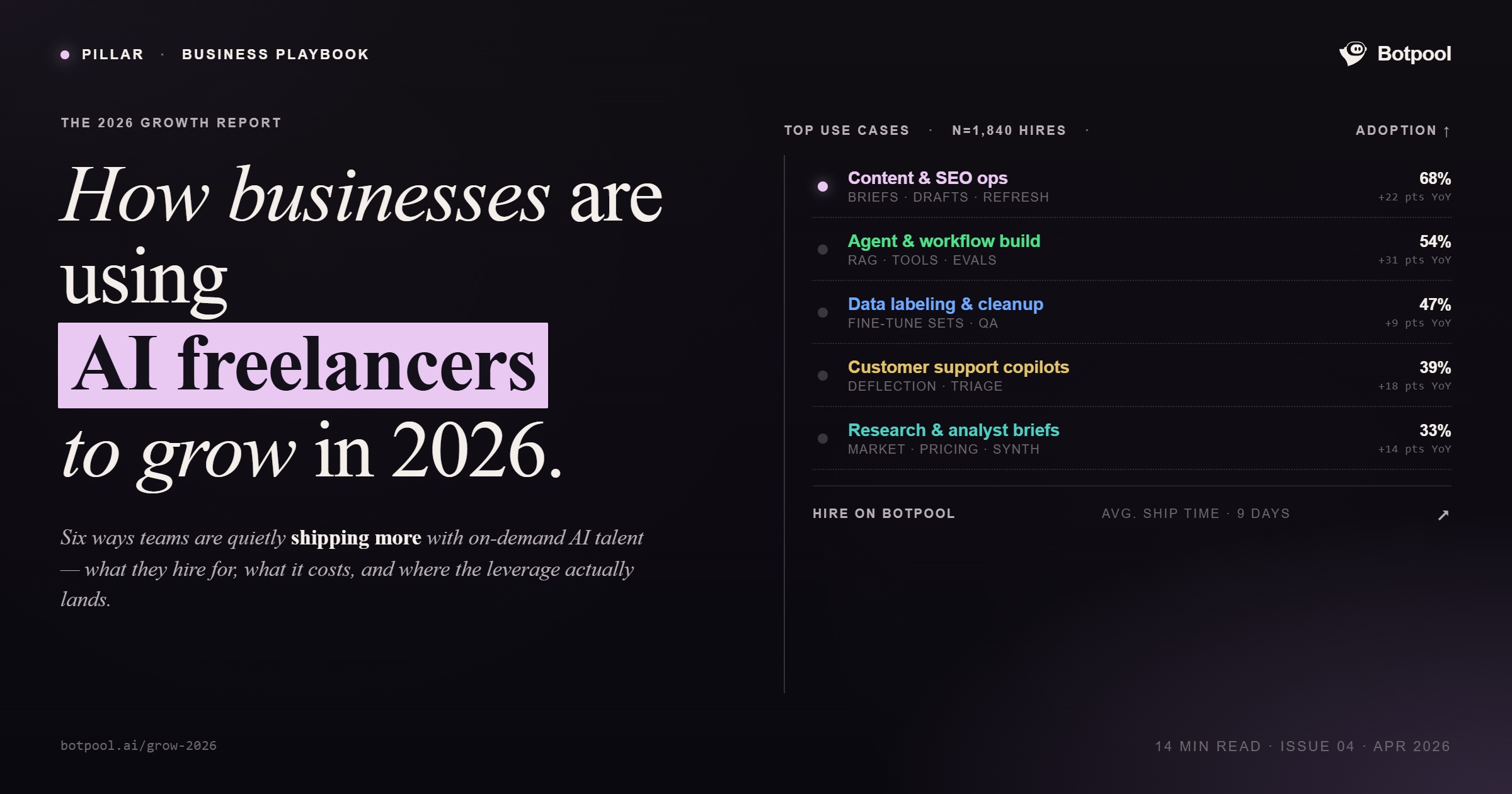
Businesses are using AI freelancers in 2026 to grow faster by outsourcing focused work like workflow automation, AI agents, customer support chatbots, content systems, reporting, and AI integrations. The goal is not to replace teams. It is to help businesses move faster, reduce manual work, and test AI projects without hiring a full internal AI team.
AI has moved from a side tool to a business growth lever. The U.S. Chamber of Commerce reported that small businesses are using AI to save time, reduce costs, improve daily work, and find new opportunities.
At the same time, companies still need skilled people to apply AI properly. Upwork’s 2026 research found that 77% of business leaders say AI is increasing their need for specialized fractional talent, rather than only broad full-time roles.
That is where AI freelancers fit. They help businesses turn AI ideas into working systems.
What Is an AI Freelancer and Why Do Businesses Hire Them?
An AI freelancer is an independent specialist who builds, integrates, or manages AI systems for businesses. Common roles include prompt engineers, voice agent developers, RAG engineers, LLM developers, and AI automation experts.
Businesses hire them to ship AI features without the cost of a full-time AI team. According to Glassdoor, the average base salary for an AI engineer in the US exceeds $130,000 per year, before benefits.
Freelance hiring removes that fixed cost and replaces it with a project budget tied to a specific outcome.
Why Are Businesses Turning to AI Freelancers in 2026?
Three forces are driving this shift.
- First, demand is outpacing supply. LinkedIn reports that AI job postings are growing at more than twice the rate of qualified candidate availability. Companies cannot wait six months for a senior hire when a freelancer can start next week.
- Second, AI work is now production-grade. Upwork's Skills Index shows AI-related freelance demand grew over 100 percent year over year. Businesses are no longer experimenting; they are shipping.
- Third, outcome-based hiring is replacing hourly billing. Deloitte found that companies using outcome-based workforce models see 30 percent faster project completion and 20 percent lower delivery costs.
What Work Are Businesses Outsourcing to AI Freelancers?
Six categories dominate the market in 2026.

1. AI Agent Setup and Management
Businesses hire specialists to build AI agents that handle multi-step workflows. Common use cases include customer support, lead qualification, internal research, and CRM updates.
These agents replace tasks that once required a small operations team.
2. Workflow Automation
Automation experts use tools like n8n, Make, and Zapier to connect business systems. They wire up CRM, email, billing, and support tools so data moves without manual handoffs.
A single workflow can save a small team 15 to 20 hours a week.
3. AI Content Production
Marketing teams hire AI freelancers to run high-volume content engines. The freelancer combines tools like Jasper, Claude, and ChatGPT with brand guidelines and SEO research to produce articles, ad copy, and social posts at scale.
Output still passes human review, but the speed jumps three to five times.
4. Voice Agents and Conversational AI
Voice agent developers build inbound and outbound AI callers using platforms like Vapi, Retell, and ElevenLabs. Use cases include appointment booking, lead intake, and tier-one customer support.
Restaurants, clinics, and SaaS companies adopt these to handle peak call volumes without hiring more staff.
5. Data Analysis and Predictive Insights
Companies use AI freelancers to set up forecasting models, customer scoring systems, and dashboards that surface decision-making insights rather than raw numbers.
This is where small businesses gain the most. They access analytics that once required a full data team.
6. Custom GPTs and RAG Pipelines
For companies sitting on documents, manuals, or knowledge bases, AI developers build retrieval-augmented generation (RAG) systems. These create internal search and chat tools that pull from company-specific data.
It turns a stack of PDFs into a working knowledge assistant.
How Are Businesses Measuring Real Results?
The serious question for any AI investment is whether the math works. Three metrics show up consistently.
- Cost savings. Businesses using flexible AI talent models reduce workforce costs by up to 25 percent (Gartner). The savings come from skipping recruitment fees, full benefits, and idle time between projects.
- Speed. Freelance specialists are on board 60 percent faster than full-time hires, according to Deloitte. For time-sensitive launches, that gap is the difference between shipping in Q2 and shipping in Q4.
- ROI on AI projects. McKinsey reports that companies integrating external AI specialists into core teams are 1.7 times more likely to scale AI successfully. Industry-specific projects deliver up to 50 percent higher ROI than generic implementations.
Real-World Examples of Businesses Growing with AI Freelancers
Most case studies in this space are anonymous or vendor-marketing. The three below are named, verifiable, and documented. Each business hired freelance AI specialists to ship something internal teams could not deliver fast enough.
AdCrush automated its ad-buying process and tripled revenue
AdCrush co-founders David Sanghera and Tony Wang needed to scale their digital ad agency without raising outside capital. Manual media buying was the bottleneck.
They engaged 10 freelance developers through Toptal over 18 months, including specialists in machine learning, web scraping, and Facebook API integration. They shipped an MVP in three weeks and released new features every week after.
The reported outcomes: 300 percent year-over-year revenue growth, 500 percent expansion of the client base, $1 million in monthly savings, and 50x ROI on the freelance engagement. AdCrush still runs with one full-time developer and five ongoing Toptal engineers (Toptal case study).
Big Sur AI shipped a prototype in days and closed $6.9M
Big Sur AI, founded by former Google executives, was building an AI sales agent for retailers. The team had deep back-end AI expertise but no front-end specialist to build an investor-ready demo.
They hired a freelance developer and UI designer through Toptal. The prototype was ready in days, not weeks.
That prototype helped close a $6.9 million seed round led by Lightspeed Venture Partners. The company was later acquired by Alphabet in January 2025 (Toptal case study, PitchBook).
What Makes Hiring an AI Freelancer Different from a Regular Freelancer?
A regular freelancer delivers work. An AI freelancer delivers a system. The output is usually a workflow, an integration, or a model deployment that continues to deliver value after the project ends. That changes how businesses scope, pay for, and manage the engagement.
It also raises the bar for vetting. A general writer can be evaluated on three writing samples. An AI developer needs technical screening, a system design review, and, ideally, a small paid test project.
How Do Businesses Pick the Right AI Freelancer?
Businesses that want to use AI can choose the right AI freelancer depending on what they are building. Use this quick reference:
Business Need | Right AI Freelancer Type |
Customer support automation | Conversational AI / Chatbot Developer |
Phone-based AI agent | Voice AI Developer |
CRM and tool automation | AI Automation Expert |
Content production at scale | Prompt Engineer / AI Content Specialist |
Internal search on company docs | RAG Engineer |
Custom model integration | LLM Developer |
AI strategy and roadmap | AI Consultant |
What Is Next for Businesses Using AI Freelancers?
Three trends will shape 2026 and beyond.
Specialized marketplaces are outperforming generalists. Vetted, AI-only platforms remove the screening burden that slows businesses on Upwork or Fiverr.
Repeat engagement is becoming the norm. LinkedIn data shows freelancers on repeat contracts cut onboarding time by nearly 40 percent. Many businesses are turning successful freelancers into long-term retainers.
Freelancers are becoming strategic partners. AI freelancers are increasingly involved in roadmap planning, architecture decisions, and model governance, not just implementation. The businesses that win in 2026 will treat AI freelancers as extensions of the team, not as one-off resources.
FAQs
What does an AI freelancer actually do?
An AI freelancer builds, integrates, or operates AI systems for businesses. Typical work includes chatbots, voice agents, automation pipelines, and custom model integrations.
Is hiring an AI freelancer cheaper than hiring full-time?
Yes, for most projects. Gartner reports up to 25 percent workforce cost reduction with flexible talent, and you skip benefits, recruitment fees, and idle time.
How fast can a business start an AI freelance project?
Specialist freelancers usually start within 3 to 7 days on a vetted marketplace. Deloitte data shows freelance onboarding is 60 percent faster than full-time hiring.
What is the difference between an AI tool and an AI freelancer?
A tool is software you operate yourself. An AI freelancer designs, deploys, and maintains the system around the tool to produce business outcomes.
Which industries benefit most from AI freelancers?
SaaS, e-commerce, real estate, healthcare admin, finance, and marketing agencies are seeing the strongest returns. Industry-specific AI projects deliver up to 50 percent higher ROI (McKinsey).
How do businesses vet an AI freelancer before hiring?
Use a vetted marketplace like Botpool, review production examples (not just demos), run a small paid test project, and confirm experience with your specific tools and use case.
Should we pay hourly or a fixed price for AI freelance work?
Outcome-based and fixed-price contracts are becoming the norm. Deloitte found these models deliver 30 percent faster completion and 20 percent lower delivery costs than hourly billing.
What is the biggest mistake businesses make when hiring AI freelancers?
Treating the project like a one-off task. AI projects produce systems, so businesses get the most value when they plan for ongoing iteration and treat the freelancer as an extended team member.
